
What Holds and What Breaks
Published May 14th, 2026 by Isabel Betsill
Six McKnight Visual Arts Fellows explore memory, perception, identity, and material transformation at the Minnesota Museum of American Art.
Banner Image: Opening reception at What Holds and What Breaks. Image courtesy of Isabel Betsill.
◼︎ ◼︎ ◼︎ ◼︎ ◼︎
The six artists comprising the 2024 cohort of McKnight Visual Arts fellows have chosen to culminate their fellowships with a group exhibition rather than the usual panel discussion. The artist-organized, artist-curated exhibition, “What Holds and What Breaks”, opened on May 7th and is on view through June 7th, 2026 at the Minnesota Museum of American Art in Saint Paul.
It is a small but impactful show that left me wanting more. Each of these mid-career artists has only a handful of pieces in the show. It’s curated down to show just one or two bodies of work or ways of thinking that each artist has explored during their two year fellowship. It left with an insatiable curiosity to get inside the minds of each of these artists, to see their larger bodies of work; their whole thought processes sprawled out in experiments, failures, and gestures.
How did Alison Hiltner get on the path of curiosity she’s currently pursuing to figure out how to communicate with plants? What failures or experiments led to Rachel Breen using a sewing machine to punch holes in paper or to figure out that threads from deconstructed garments keep a memory of their former shape? How did Sophia Chai even figure out that the illusions she creates are possible? Where and how did Dahn Gim gather her materials?

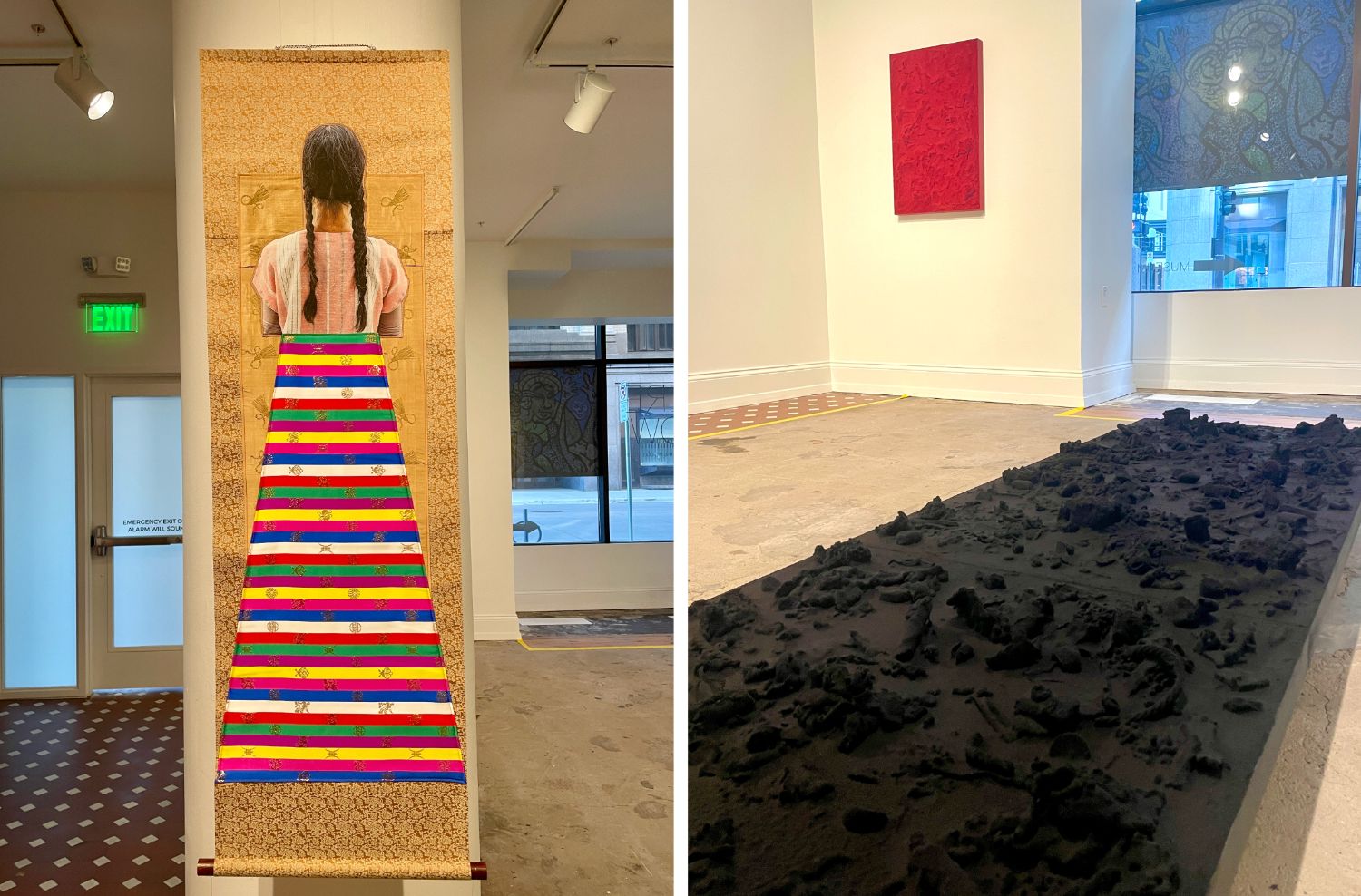 Top Image: My Darling Companions by Rachel Breen. Bottem left: Padre Madre by R. Yun Matea. Bottom Right: Untitled (Known Unknown I) and Untitled (Known Unknown II) by Dahn Gim. Images courtesy of Isabel Betsill.
The show reads a bit like a thesis show. It felt disjointed at times as all artists are firmly engulfed in their own well-developed practices and visual languages by this point in their careers. However, after two years of learning from each other, critiquing, and collaborating, they were insistent on having this show in order to see how their works would talk to one another. By listening to and observing closely this cross-disciplinary communication, the viewer can draw conclusions about the themes and ideas that have grasped the attention of this generation of artists at large. For this group, those themes and ideas include identity, memory, history, perception, and transformation.
If I were to summarize the show with one concise conclusion, it would be that things are not always what they seem. Take Sophia Chai’s photographs for a more literal example. Many viewers first mistake her work as being paintings. While her visual language is reminiscent of midcentury modern painters like Rothko or Mondrian, Chai’s works are actually photographs of a 3-dimensional interior space that has been modified with paint to obscure the viewer’s sense of perspective.
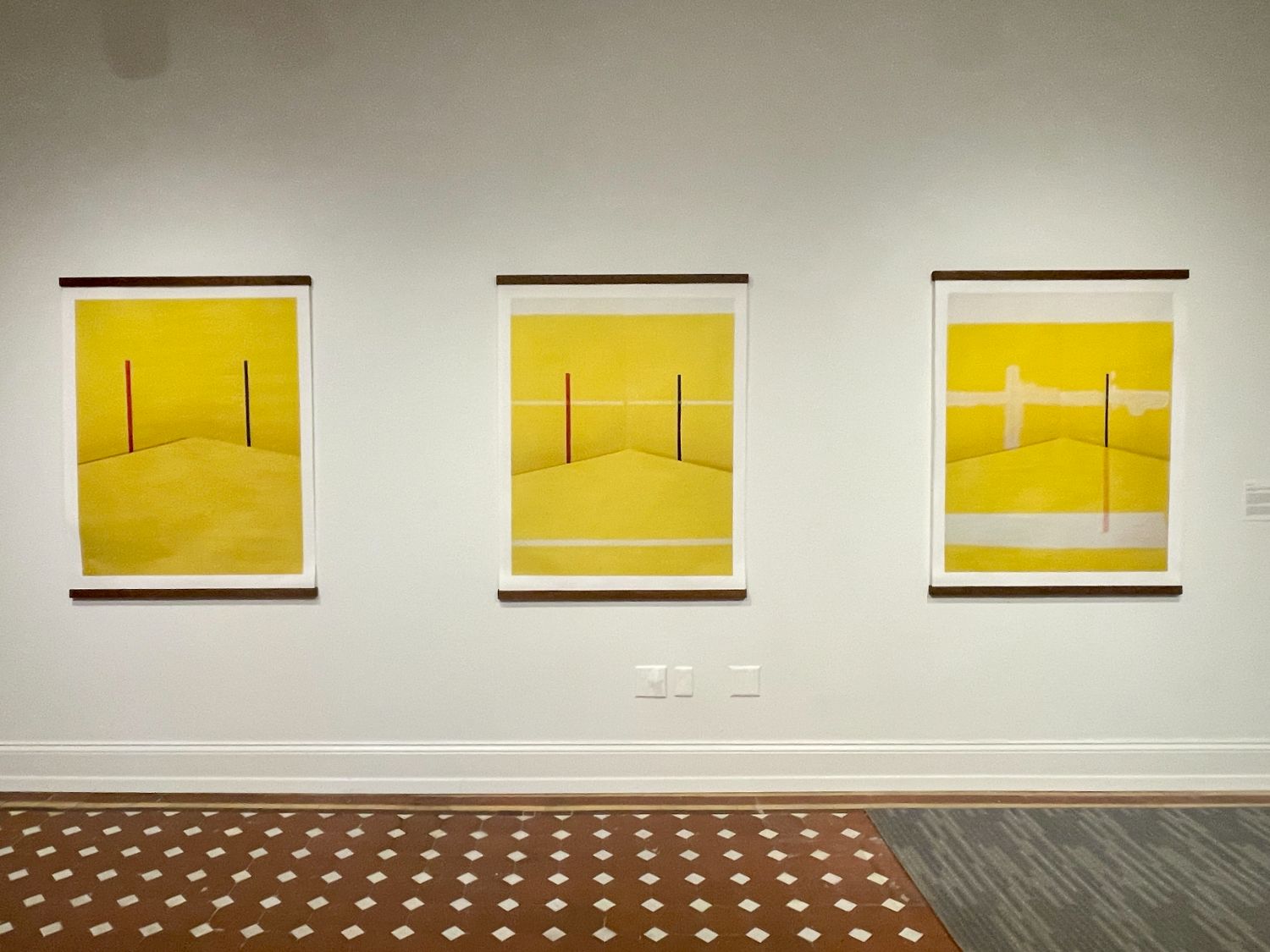 Installation view of Mother Photography by Sophia Chai. Image courtesy of Isabel Betsill.
Clockwise in the room from Chai’s work is that of Chris Rackley. At first glance, his work appears as little more than an architectural diorama. However, get up close and walk around the backside and you’ll notice the details and remnants of a lived experience: a child’s left behind action figure, a skateboard, specifically-labeled packages. Rackley has constructed a diorama conglomeration of shopping malls based on memories of his childhood spent in his father’s shoe stores in malls. In this work, the viewer’s understanding of reality is again being put to the test. How and when do memories get stored with immense detail and precision, and when do they leave gaps? Analyzing our warped sense of the world we construct through memory is what creates meaning in Rackley’s work.
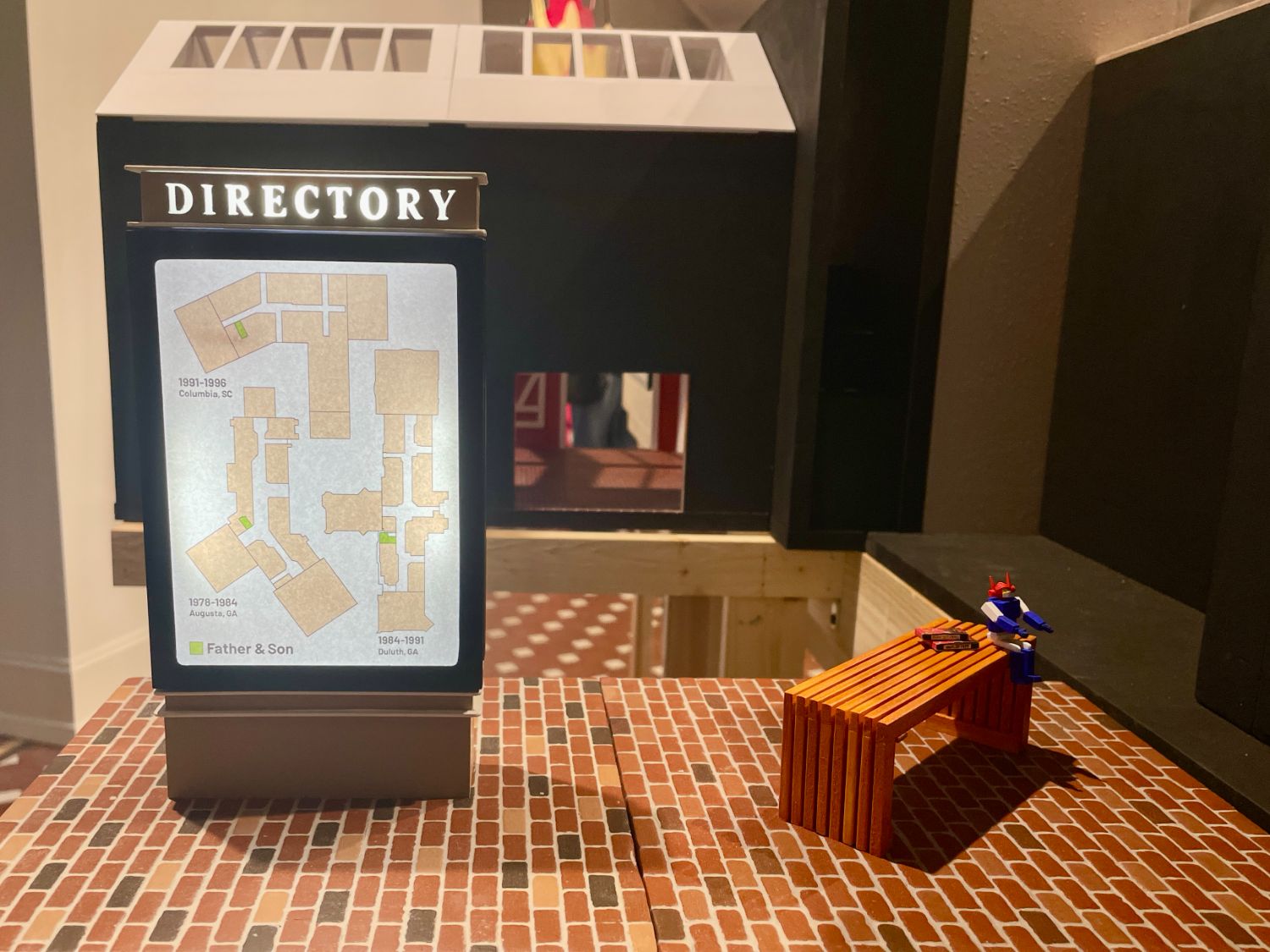 Image: Detail of Chris Rackley's scale model of Gwinnett Place Mall. Image courtesy of Isabel Betsill.
Each artist’s work in this show is packed with meaning about not only who each of these artists are, but the world we inhabit and our senses and limitations in interacting with said world. Identity, memory and history are all transient and subject to transformation through shifts in perspective.
A final thing that stood out to me is how each of these artists is, in their own way, pushing the limits of their respective mediums. There is not a monodisciplinary artist in the bunch. As aforementioned, there’s Sophia Chai hybriding painting and photography. Chris Rackley incorporates video and drawing into his sculptural work. There is also Rachel Breen and R. Yun Matea who have constructed unique visual languages assisted by the history and memory contained in textiles. Alison Hiltner brings her edge for science with a flair of absurdity to sculpture, and Dahn Gim’s work is built of objects most people would overlook, but which give meaning to the way identity is constructed, deconstructed, and reconstructed.
 Image: Detail of Reverberations by Rachel Breen. Image courtesy of Isabel Betsill.
There is some great entertainment to be had simply reading the materials list for each work of art in this show. The way humble materials have been transformed into curiosity-inspiring pieces exploring identity, memory, history, perception, and transformation, is a great feat that speaks to the talent and deservedness of this group of McKnight Visual Art fellows.◼︎
What Holds and What Breaks, is on view at the Minnesota Museum of American Art in St. Paul up through June 7.
We can't do it without you.
Help keep independent arts journalism alive in the Twin Cities.
We can't do it without you.
Help keep independent arts journalism alive in the Twin Cities.