
2024 McKnight Visual Artist Fellow: R. Yun Matea
Published May 26th, 2026 by Laura Laptsevitch
The persistent ties between labor, memory and place.
 Article made possible thanks to the
 McKnight Visual Artist Fellowship Program. Administered by the Minneapolis College of Art and Design.

Banner Image: El Cenote. Image courtesy of Rik Sferra.
◼︎ ◼︎ ◼︎ ◼︎ ◼︎
This is the sixth in a series of articles profiling the six distinguished artists chosen as 2024 McKnight Fellows in Visual Arts, a grant program for mid-career artists in Minnesota that is administered by the Minneapolis College of Art and Design. The 2024 cohort includes Rachel Breen, Sophia Chai, Dahn Gim, Alison Hiltner, R. Yun Matea, and Chris Rackley.
Their two-year fellowship has culminated with a group show, What Holds and What Breaks, currently on view through June 7 at the Minnesota Museum of American Art in St. Paul
◼︎ ◼︎ ◼︎ ◼︎ ◼︎
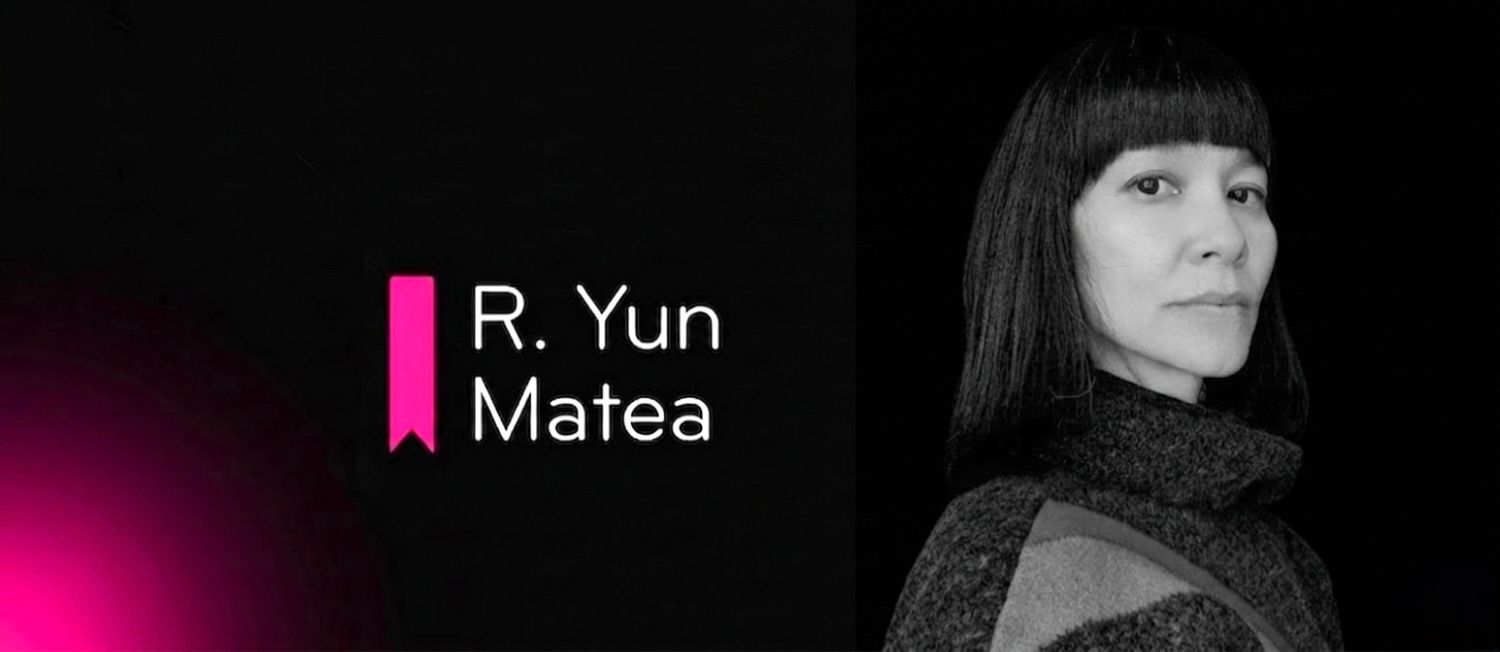 Photo courtesy of R. Yun Matea.
I first encountered R. Yun Matea’s work the way I encounter much of what I see these days: in conversation. I sat down with Matea at the Minnesota Museum of American Art, where we spoke about her life and career leading up to What Holds and What Breaks, on view just down the hall.
Matea is an interdisciplinary and moving image artist raised in rural California and Guatemala. Her research-based practice investigates archival, historic and mythic conceptions of language, race, time, disease and ecology. She holds an MFA in Film and Media Arts from Temple University and a BA in Geography from UC Berkeley, and has taught at MCAD, Carleton College, the University of the Arts Philadelphia, and UC Santa Cruz.
Matea’s work is shaped by movement across places and identities. Multiracial, raised between cultures that never fully contained her, she was drawn early to nonlinear creative expression and filmmaking as both method and necessity. “I venerate real lived experiences,” she told me. “And even if I’m making something mediated, I want to honor the tactility of it—our senses, the experience of being in the world.” That sensibility extends back to her earliest work.
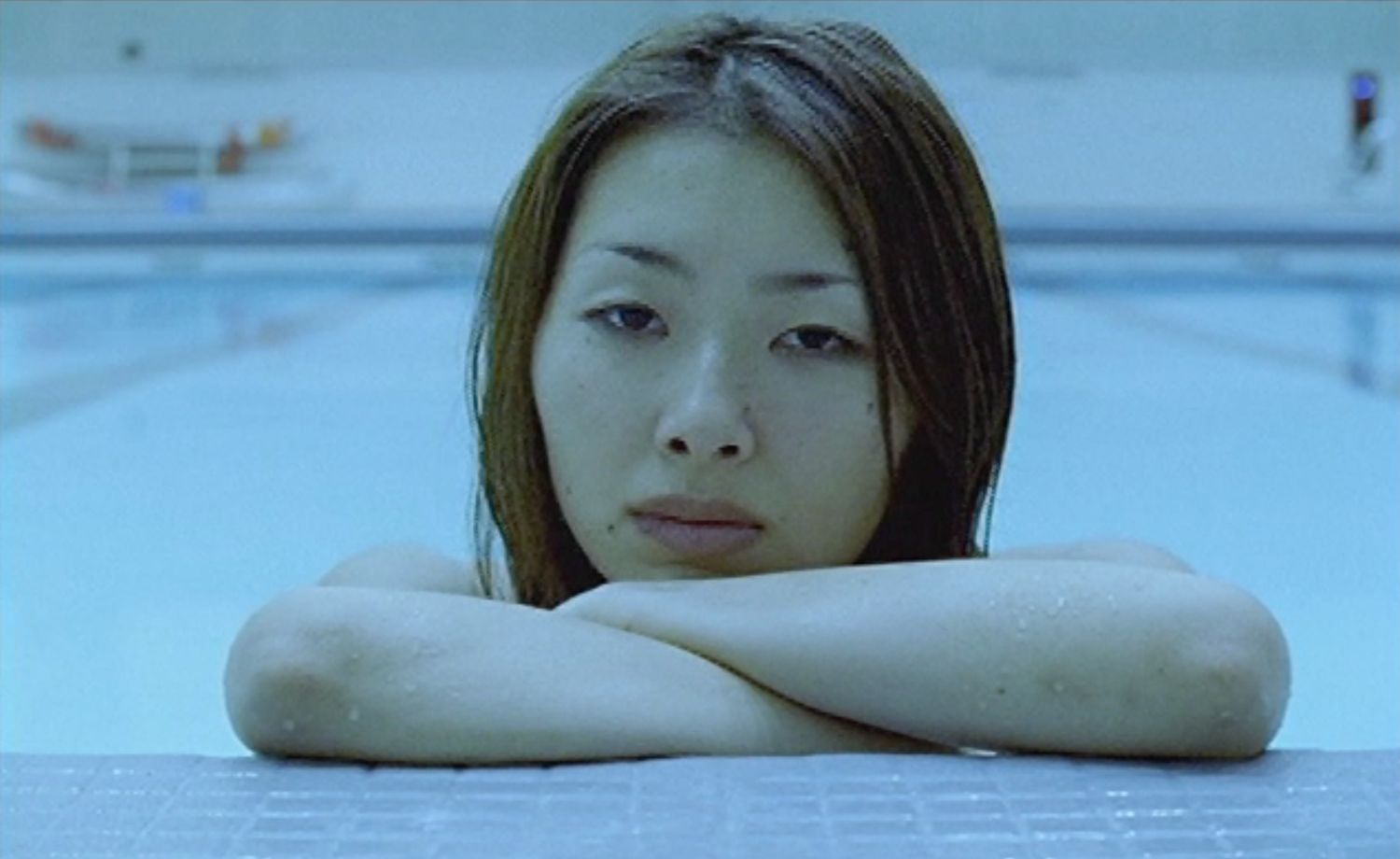
 Yellow 2005-2007, 7 min, 16mm, color. Images courtesy of R. Yun Matea.
Her favorite film, she told me, is the one she made for graduate school applications—shot intuitively in California and France on a small Sony camcorder, assembled through rhythm and montage rather than narrative logic. It has since been lost. But the approach it represents remains central: the camera as a mediating device, observation as form.
“I want the viewer to bring their own experiences,” she said. “I don’t want to tell them how to think.”
Graduate school complicated that instinct. Her MFA training pushed toward conventional narrative cinema, producing what she describes as an identity shift layered on top of earlier dislocations. “It took many, many years to start feeling like I could play again.” Much of her later work grows from that return.
El Cenote
It’s fair to say she started playing again. Across projection, sound, vibration, and layered imagery, Matea constructs immersive environments that ask viewers not simply to watch, but to inhabit time. One of the clearest examples is El Cenote (2021), a large-scale installation developed during the pandemic and exhibited at the Katherine E. Nash Gallery.
El Cenote draws on Mayan mythology and lived experience, moving across time through cenotes—circular limestone formations in the Yucatán and Guatemala shaped over thousands of years.
Sacred to ancient Maya civilizations and still regarded by some contemporary Maya communities as sites of burial and offering, the cenotes were excavated in the early twentieth century by archaeologists who recovered artifacts and ancient human remains. Another circular form, the large disused man-made wells found in towns and villages, later have become sites where forensic teams exhume the remains of victims of the Guatemalan Civil War.
“They’re now exhuming the bones, identifying them, returning them to their loved ones.” The same form persists; the meaning changes.

 Installation view, El Cenote / Pacaya y Tikal 2021. Images by Rik Sferra, courtesy of R. Yun Matea.
The work began with a personal search. As a resident researcher at the University of Minnesota’s Immigration History Research Center Archives (IHRCA), Matea looked for firsthand accounts of the Guatemalan Civil War. Her uncle had been killed during that period, and she hoped to find traces of him. Instead, she encountered only reports and institutional records. “There were no first-person accounts,” she said.
Running alongside this research was a study of Mayan cosmology. The two threads met in the figure of the circle: cenotes, circular maps, lunar cycles, sinkholes that open unexpectedly in Guatemala City. “I was thinking about an underworld,” she said, “and about excavation—down into the earth and upward into time.”
An obsidian disc animates the work, drawing on the Mayan use of volcanic glass for divination. In motion, it binds geological time to speculative vision, making the past a surface for seeing forward.
The installation itself was monumental—nine feet high and thirty-two feet wide—combining video, sound, sand, stone, and mulberry paper. The rotating visuals and vibrating bass soundtrack struck visitors. “The idea was that you would feel time moving through you,” she said. The work does not illustrate history; it places the viewer inside it.
Tzolk'in / Count of Days
That same instinct—to let objects carry more weight than the people moving around them—is at the center of Tzolk'in / Count of Days (2020).
The film began with four hours of quiet, solitary observation in a small room at the National Museum of Anthropology in Mexico City, a monumental 1960s building organized around a central courtyard dominated by El Paraguas (“The Umbrella”), the iconic structure formally named by its architect, Pedro Ramírez Vázquez, from which water cascades downward.
It happened to be raining the day Matea was there. She spent most of those hours alone with the Maya objects of Chichen Itza, the way she often is in museums and archives, watching and sensing.


Tzolk’in/ Count of Days 2020, video, color. Images courtesy of R. Yun Matea.
Standing among the artifacts, she began to feel as though the visitors were the ghosts and the objects were the living things. "The objects felt more alive, more vivid, more permanent than the people walking around them." That inversion became the emotional core of the piece. Footage was treated with solarization and color inversion—saturated hues pulsing against darkened backgrounds—making ancient objects feel startlingly present while the human figures around them seem to fade. "I wanted viewers to feel as though they had switched places with the object, reversing the relationship between observer and observed."
When she showed me the film in that dim room, I told her that watching it, I felt like the artifact—like something old and persistent, looking out at a strange world that had been built around me while I wasn't paying attention. She lit up. "Yes. That's exactly it."
North/Central (ongoing)
From large-scale installations and institutional archives, Matea turns toward something more intimate: her father.
A farmer from Guatemala, he spent years in the United States with the intention of returning to agriculture. He eventually settled in Costilla County in southern Colorado.

R. Yun Matea, North/Central (ongoing).
The San Luis Valley carries layered histories: Ute land, Spanish settlement, and long-standing irrigation systems that still shape agricultural life today. Into this landscape, her father arrives as an outsider. Over two decades, that position shifts. His agricultural knowledge—rotational grazing, grass-fed cattle—gradually earns recognition among neighbors who once overlooked him.
The film follows the rhythms of his labor: driving, hauling hay, tending cattle under an expansive sky. At moments, he recites passages from the Popol Vuh, which sit alongside his Christian faith and the landscape around him.
Inside the house, the tone shifts. The interior is dense with tools and materials, a space Matea recognizes from her own childhood.
At a later point, she inserts herself into the film as a child wearing Korean clothing. The frame fractures. What had been developed as separate narratives—her father, her heritage—collapse into one. “I couldn’t keep separating things,” she said. So she stopped.
 Portrait of the artist in her childhood hanbook dress. Still from North/Central.
What connects these works is not a single subject, but a refusal to keep categories intact. Matea resists linear narrative and stable identity as organizing principles. Instead, she works through fragments—materials, histories, and sensory experience that accumulate rather than resolve.
Her films do not explain experience so much as forge conditions for encountering it. Viewers are not positioned outside the work but inside its unfolding.
I left our conversation thinking about the circle—not as symbol, but as structure. It returns across her work: in cenotes, museum objects, agricultural fields, and recurring historical wounds. In place of linear coherence, Matea offers recurrence: forms that return without resolving, carrying history forward without closing it.
The themes that circulate through Matea’s films—inheritance, repetition, and unresolved histories—reappear in a new form through her textile work. At What Holds and What Breaks, Matea decided to work on something entirely new, two textile works hanging across each other in the gallery. The installation marks the first time she has worked with fabric as a primary medium.
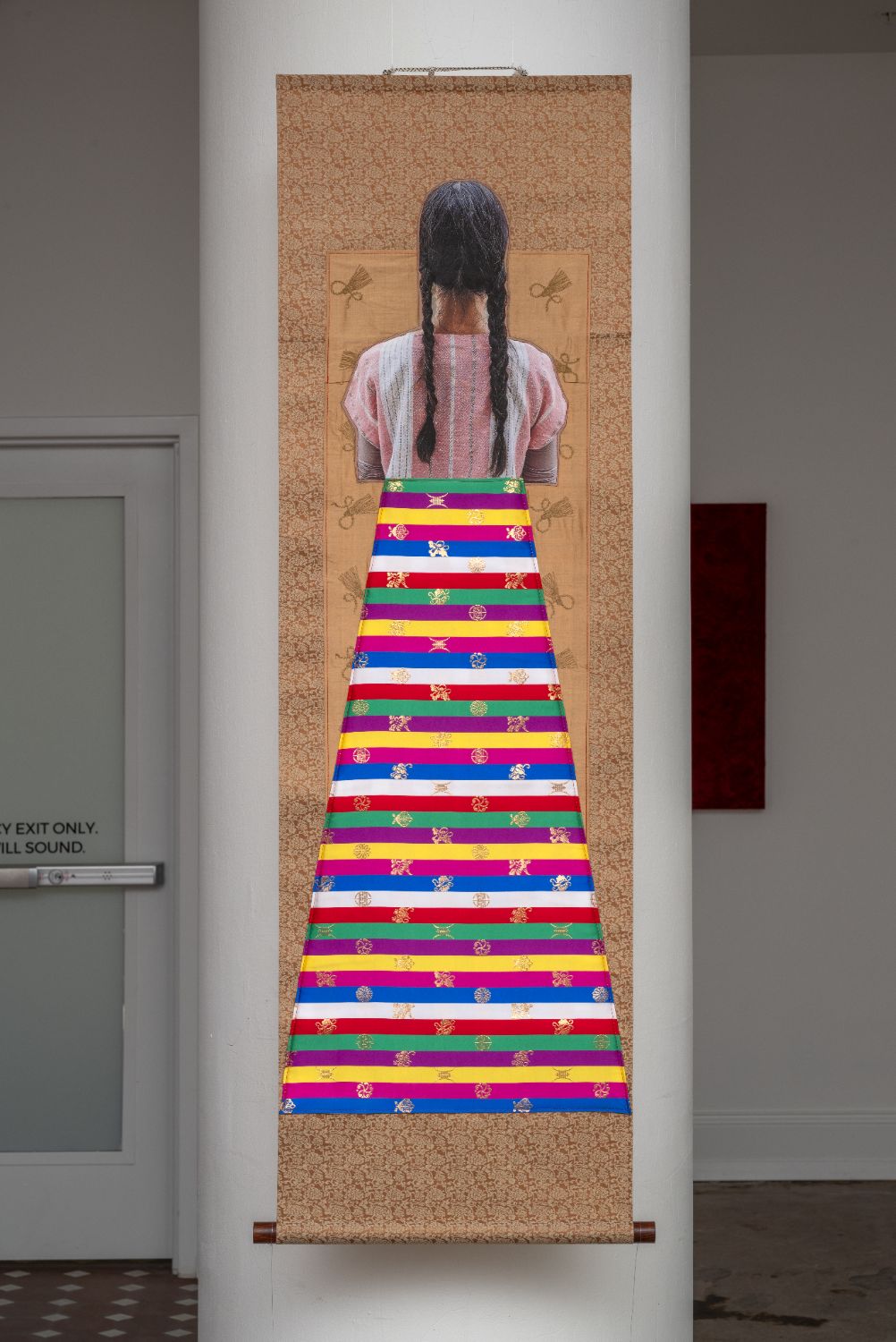 Installation view of "padre/madre (dos-à-dos)" at What Holds and What Breaks. Image courtesy of R. Yun Matea.
Titled padre/madre (dos-à-dos), the diptych reflects the cultural disparities and early separation of her father and mother, through paired self-portraits. In both pieces, the figure is the artist herself standing in as each parent, shown from behind with her back turned toward the viewer. The material ground for each piece utilizes the form of the Guatemalan tzute weavings and the silk-on-mulberry-paper Korean scrolls (jokja) that hung on the walls of her early childhood home before these two aspects of her parents would never again come together, except in the artist’s lived body. Together, the two works form a portrait of ancestry and cultural inheritance through familial fracture.
Matea’s films and installations return to what persists: objects, histories, and wounds that continue to move through the present. Rather than offering closure, Matea leaves viewers inside the ongoing weight of remembrance.◼︎
Visit R. Yun Matea's website at siblingprojects.com or follow her on Instagram @tinyocelot.
We can't do it without you.
Help keep independent arts journalism alive in the Twin Cities.
We can't do it without you.
Help keep independent arts journalism alive in the Twin Cities.