
Where We Come From
Published February 28th, 2026 by Zakiah Goff
The 2024/2025 MCAD–Jerome Fellowship Exhibition considers family, fracture, and what it means to find home.
Banner Image: Convocation, by Namir Fearce. Image courtesy of Zakiah Goff.
◼︎ ◼︎ ◼︎ ◼︎ ◼︎
I take the bus to the Minneapolis College of Art and Design (MCAD) on a gray, snowy afternoon. The sidewalks, fire hydrants, electrical boxes, and apartment building windows are plastered with signs that read “ICE Out.”
In a moment when families are being separated and people are being taken from the only place they’ve known as home, the word “home” itself begins to feel indefinable. Home is no longer where you live or where you come from; it’s now shaped by policy, by borders, by power. Who gets to stay? Who is forced to leave? Who belongs, and who is expected to assimilate in order to belong?
In the 2024/25 MCAD-Jerome Fellowship Exhibition, early-career artists grapple with what it means to build a life, artistic practice and home in Minnesota.
 Installation view of 2024/25 MCAD–Jerome Fellowship Exhibition. Image courtesy of Zakiah Goff.
Namir Fearce: I’m Building Me a Home
I entered interdisciplinary folk artist Namir Fearce’s installation through black curtains and gospel music playing softly. In a Jerome Fellow interview, Fearce states that his practice is informed by what he calls “a constellation of Black familial sites of memory” and that is clearly reflected in his experimental work. The space is arranged with church pews facing a projection where a pastor might stand but instead, a video titled “Convocation” shows Black people singing in ceremonies, classrooms and churches. Not just one fixed sanctuary, but many.
The video opens with a miniature church from Fearce’s sculpture “Come On In the Room.” Faceless figurines crowd at the door, entering and exiting the church in an endless loop. The song “I’m Building Me A Home” by School Daze begins to play, alongside videos of Fearce and his family getting ready for church. The song remixes into a Masters At Work club track “HA Dance” as the visuals bleed into energetic depictions of ballroom culture.
 Installation view of Convocation and Come On In the Room, by Namir Fearce. Image courtesy of Zakiah Goff.
While Blackness, queerness and faith do not always sit easily together, Fearce hones in on its coexistence. The line “I’m building me a home,” then, begins to mean multiple things: church as home, chosen family as home, Blackness and queerness negotiating space.
In the sculpture “Burning Bush,” two African women stand, their torso’s intertwined against a red wall where wheat stalks surround them. One holds a gun and smiles wide, teeth exposed. The other woman raises her arms triumphantly. At the base, dolls of Black children hold the structure up and behind me a choir repeats in a soothing register, “you’re my baby, that’s my beautiful baby.”
During the antebellum South and Jim Crow era, Black children were placed near alligator haunts as bait for nearby hunters, a practice that Fearce previously explored in his video Salacious Sanctity. The tenderness of the song clashes with the historical violence. I think back to Fearce's interview where he describes home as a womb, “a place that can both nurture and kill.” That contradiction becomes physical as protection and peril are held in the same breath within his installation.
Ger Xiong: Don’t Let Go
Ger Xiong immigrated to the United States as a Hmong refugee of the Vietnam War in 1993, and it’s clear that his cultural identity grounds his practice. His pieces incorporate Hmong jewelry, textiles, colors and currency to explore the circulation of French Indochinese coins during the colonial occupation of Indochina.
In his Jerome Fellow interview, Xiong talks about the material history behind his work:
“Historically, Hmong silversmiths would melt these silver coins down and repurpose them into our jewelry and silver bars,” Xiong says. “I am interested in this act of destruction of colonial currency and reimagining and reshaping the materials into our jewelry.”
 Installation view of KUV YOG HMOOB, by Ger Xiong. Image courtesy of Zakiah Goff.
Xiong extends that gesture by drilling into the coins and embroidering Hmong patterns and language onto their surfaces. In his piece KUV YOG HMOOB, which translates to “I am Hmong,” the phrase appears stitched across a large brass Indochinese coin. The embroidery physically pierces the metal, weaving Hmong language directly into an object that once symbolized colonial control. The act and energy of the piece feels both destructive and reparative as bright threads cut across aged metal. Cultural heritage stark against colonial oppression.
In another piece titled Come Back, Xiong embroiders colorful thread — colors drawn from Hmong clothing and textile traditions — onto replicated French Indochinese coins. One section of stitching is missing from the piece and the absence feels intentional as the gap interrupts the pattern, creating a small rupture in an otherwise careful design. The message becomes more subtle but still clear: assimilation leaves gaps, but identity persists.
Xiong’s intervention is materially precise as he alters the objects of colonization itself. I find myself circling his work multiple times. Home, here, is language and craft carried forward despite erasure.
Nik Nerbern & Amy Usdin: What We Carry
While Fearce and Xiong reconcile with historical violence in their work, cross-disciplinary artist Nik Nerburn and fiber artist Amy Usdin examine how familial roots, memory, and found materials shape their work.
In Nerburn’s digital video “No Such Thing As Bad Weather,” a vintage dollhouse looks tattered and lonely. Plastic is taped over windows in a failed attempt to insulate a Midwestern winter, pencil scratches against floral wallpaper, a broken plant pot in the living room. He uses puppetry to explore the emotional distance and fragile stories within a household.
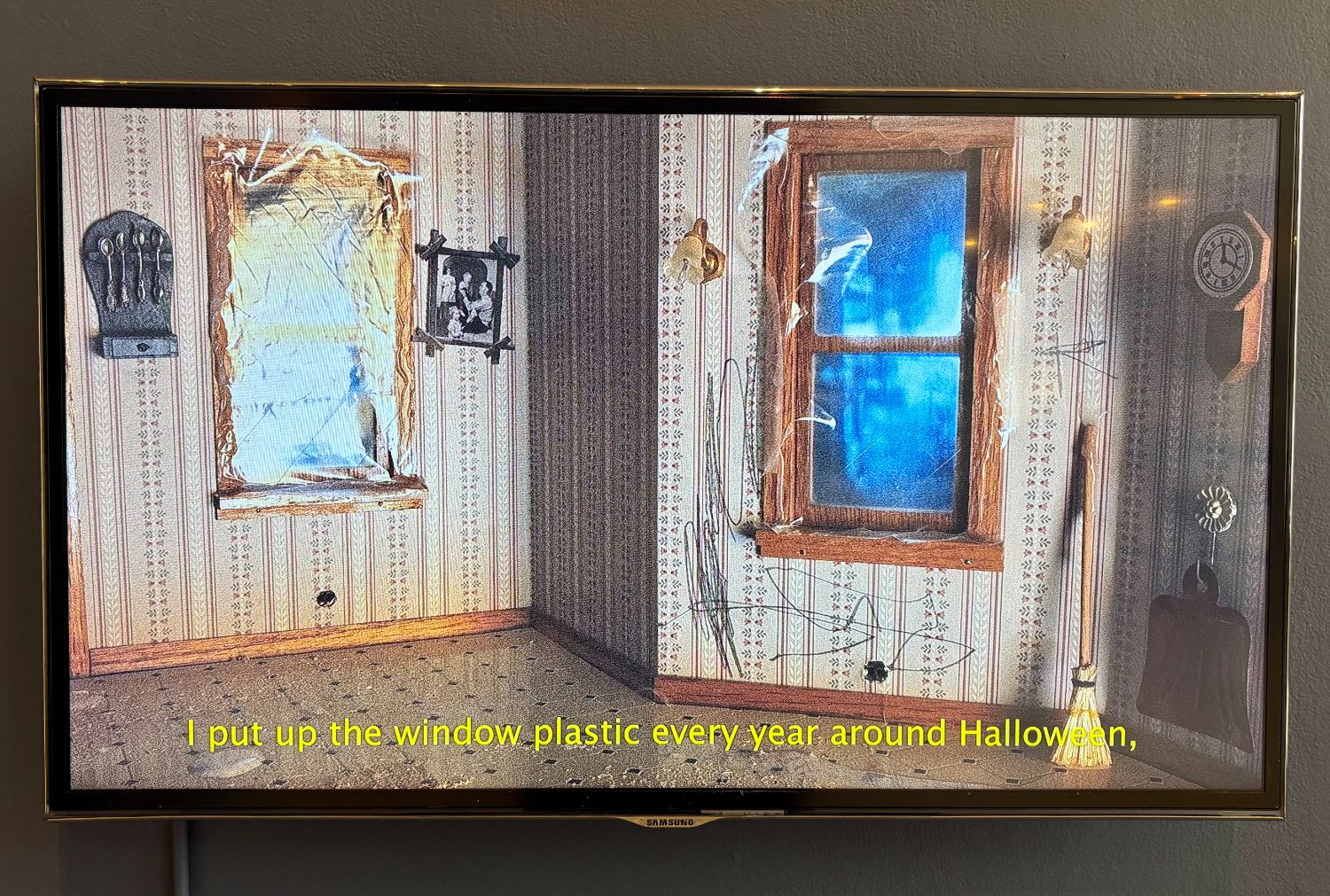 Installation view of No Such Thing As Bad Weather, by Nik Nerbern. Image courtesy of Zakiah Goff.
“A puppet is just a stand-in for something else,” Nik Nerburn explains in his Jerome Fellow interview. “It’s a way for a deep feeling to put on a disguise and become real in front of us.” Usdin incorporates fishing nets, horsefly masks, animal hair, plant fibers, and other worn materials into pieces that resemble muted landscapes and horizons. Some works resist romanticism as they sag, pull, and knot.
In her Jerome Fellow interview, Usdin describes turning more fully to weaving while caring for her aging parents, drawing a parallel between tending to bodies in decline and tending to objects that had outlived their original use. Within the exhibition, Usdin’s practice stands out as an act of maintenance. If other artists in the gallery confront rupture more directly, Usdin stays with the aftermath.
 Installation view of Theft of Matter, by Amy Usdin. Image courtesy of Zakiah Goff.
Taken together, the exhibition resists the idea that art emerges from a vacuum. Instead, it insists that artistic practice is formed through confrontation with what came before. Whether through film, embroidery, puppetry, or weaving, each artist reveals that what we create is shaped by what we inherit.
The 2024/25 MCAD-Jerome Fellowship Exhibition will be on view through Saturday, March 7.◼︎
You can view the 2024/25 MCAD-Jerome Fellowship Exhibition at the MCAD Galleries Fri, Jan 16, 2026, 10:00 a.m. —Sat, Mar 7, 2026, 6:00 p.m.
We can't do it without you.
Help keep independent arts journalism alive in the Twin Cities.
We can't do it without you.
Help keep independent arts journalism alive in the Twin Cities.