
Paris Couture at Mia
Published November 16th, 2026 by William Gustavo Franklin Torres
A recent visit to Mia’s sweeping survey of haute couture
Banner Image: Left: JACQUES HEIM, SUREAU (ELDERBERRY TREE) DRESS, 1966, wool twill flannel by Gérondeau; Center: YVES SAINT LAURENT, COCKTAIL DRESS from Mondrian series, 1965-66, "Paris-Midi" wool jersey from Racine; Right: PIERRE CARDIN, CIBLE (TARGET) DRESS, Spring-Summer 1966, "Matefin" wool muslin from Staron. Photos by William Gustavo Franklin Torres.
◼︎ ◼︎ ◼︎ ◼︎ ◼︎
An Art Nouveau-inspired archway welcomes visitors to the new Minneapolis Institute of Art exhibition Paris Couture, a mostly Twentieth-century exploration of couture spanning from 1890 to the present, enough fashion designs to delight the many tastes of followers and newcomers. I went to see the exhibit twice, I was delighted and transported both times (my second visit on a Wednesday at 10AM proved to be the least crowded).
Paris Couture is arranged chronologically across ten individually curated sections ranging from the founding of the House of Worth in 1858, passing through The Roaring Twenties, The Thirties Reinvention Through Crisis, Wartime Occupation, A New Golden Age, An Age of Revolution, Decline, all the way to An Age of Revolution, Globalization and The 2020s. Paris Couture was conceived by the Palais Galliera (Paris Fashion Museum) and Paris Musées, in collaboration with Mia under curator Max Bryant, and the Saint Louis Art Museum where it will also be on display in March 2027.
A total of eighty-three high-end sewing (haute couture) fashion designs are on display (I’ll just refer to a few personal favorites here). The exhibition makes its point of departure the 1850s, the time of Paris’s urban and cultural renewal under French official Georges-Eugène Haussmann, known as Baron Haussmann, responsible for many of the city’s public work projects and aesthetics transformations which also shaped fashion.

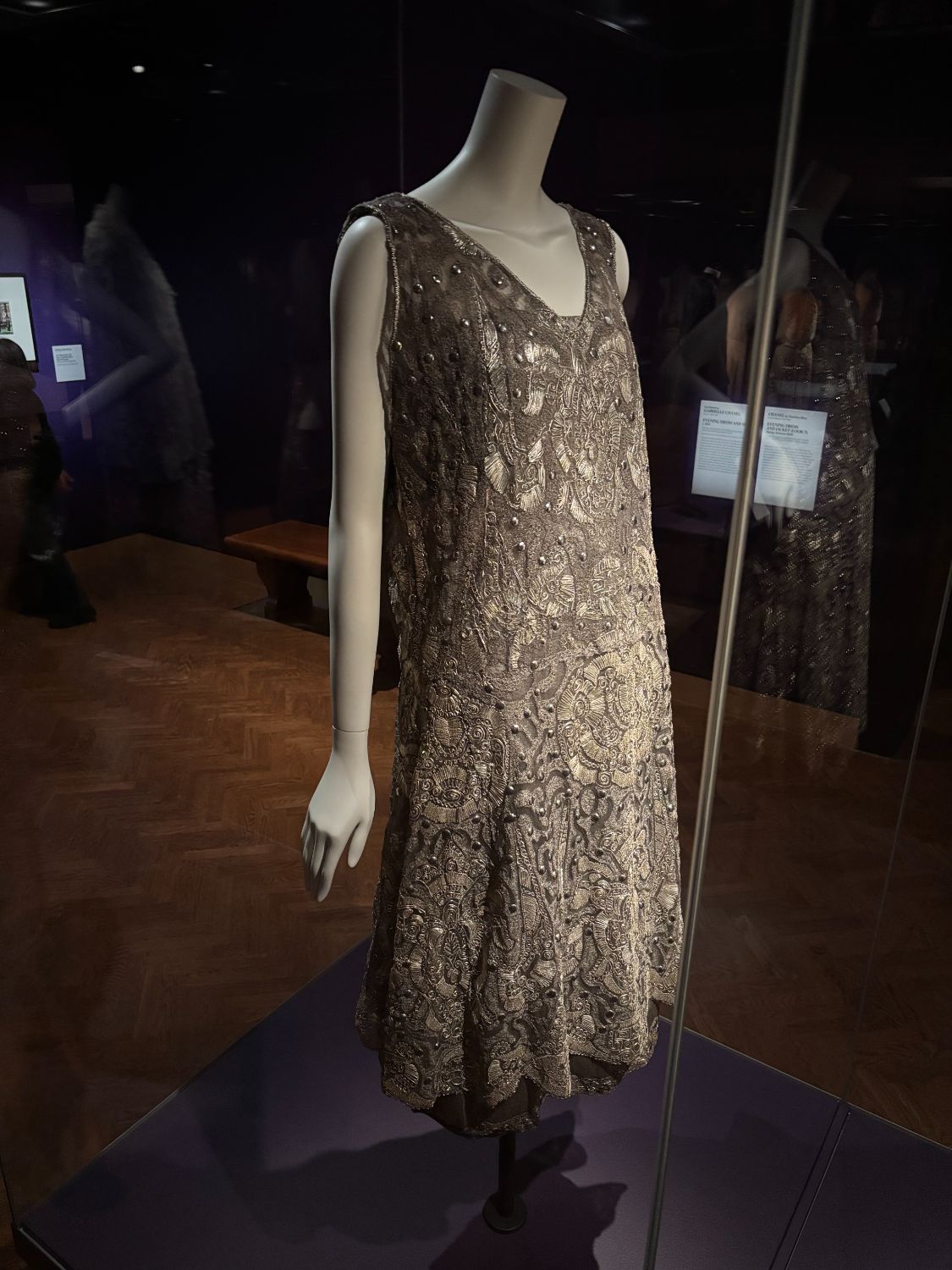 Top image: MADELEINE VIONNET, EVENING DRESS, 1922, silk chiffon embroidered by Lesage, metallic threads, beads, micro-tubes, faceted round rhinestones. Bottom image: GABRIELLE CHANEL (Coco Chanel), EVENING DRESS AND SLIP, 1924, silk tulle embroidered with metallic thread, plastic cabochons (polished gemstones), lamé. Photos by William Gustavo Franklin Torres.
Upon entering the Roaring Twenties, I was immediately awestruck by a green silk robe du soir, evening dress, with cascading beaded work by Madeleine Vionnet (1876-1975), one of Europe’s greatest courtiers. The only way I can describe the experience is with a sense of awe, something remarkably beautiful, sensual, and classic to hold in fervent admiration forever. It was also memorable to see Coco Chanel’s (1883-1971) evening dress and slip from 1924 for its sophistication down to the smallest details and for its lightness (for more on Coco Chanel’s controversial profile due to her later actions and associations during World War II see here).
Then came my encounter with Edward Molyneux’s (1891-1974) blue silk velvet pane evening dress with its long sleeves reaching the floor, which took my experience to an even a higher level. Molyneux was a British fashion designer who operated a salon in Paris from 1919 until 1950. At this point of my visit I remembered saying to myself, Baudelaire was right, fashion is the vital and the defining philosophy of modernity. Paris Couture had become something more akin to poetry and music to me, I was truly elevated by everything I was seeing.
 Image: MOLYNEUX (Edward Molyneaux), EVENING DRESS, Autumn-Winter 1935-36, silk velvet pane. Photo by William Gustavo Franklin Torres.
A somber mood took over me when I walked into the section titled Wartime Occupation and I saw an enlarged photograph of a desolated Place Vendôme and the Vendôme Column, a central symbol of the occupied city in 1940. In front of it four dresses, the one to the left of visitors, a vintage green dinner dress attributed to prominent fashion designer Marcelle Dormoy (1895-1981) from Autumn-Winter 1942-43. Made with crepe embroidered with metallic thread and sequins, the dress had an imposing presence on the stage and under the light. The other three designs to the right were those of Jeanne Lanvin (1867-1946), Jeanne Paquin (1869-1936), and one from the House of Grès founded in Paris by Madame Grès (1903-1993) in 1942.
A sublime cocktail dress with a sweeping sheer lace back panel made by Yves Saint Laurent (1936-2008) in 1970, but inspired by Parisian fashions of the 1940s, stops any of the visitors on their tracks. I must say I was also captured by the melancholic and lushly melodic music playing through the speakers in the gallery, which my Shazam app recognized as “Anne et Claude” by French composer George Delerue (1925-1992).

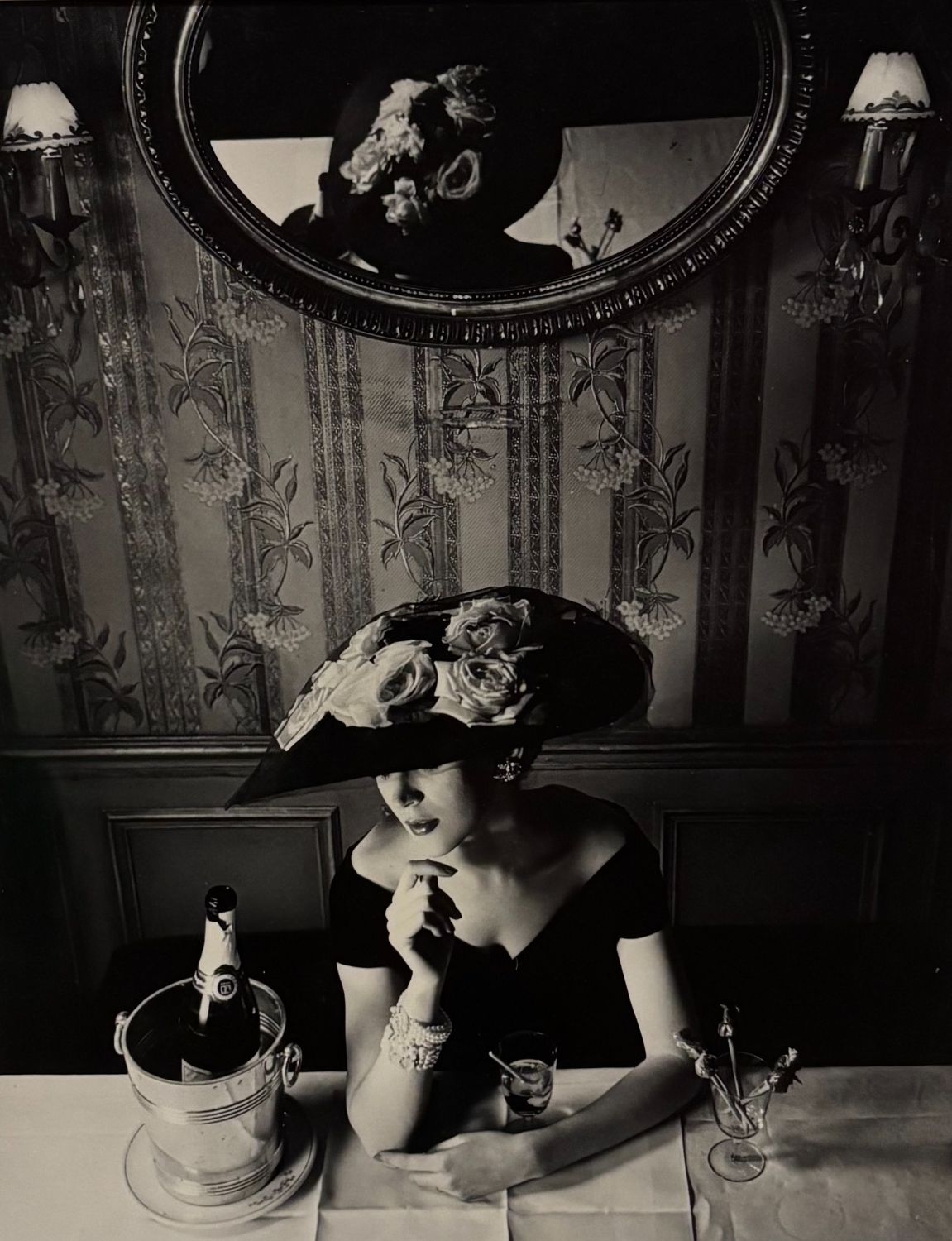 Top Image: YVES SAINT LAURENT, COCKTAIL DRESS, Autumn-Winter 1970-71, wool crepe from Gandini, machine-made silk lace from Brivet. Bottom Image: Detail of HENRY CLARKE, CHRISTIAN DIOR HAT, in Lapérouse restaurant, published in Vogue, American and English Editions, April 1956, gelatin silver print. Photos by William Gustavo Franklin Torres.
Personally speaking, it was hard to focus on the next period, A New Golden Age, and the other sections after that, my fascination and attention had been completely robbed already by the earlier fashion designs. I did stop to admire a series of photographs, gelatin silver prints, by American fashion photographer Henry Clarke (1917-1996), who launched his career in Paris in 1949 (Clarke worked for the American, French, and British editions of Vogue from 1950 to the late 1970s). The photograph of a model wearing a Christian Dior Hat at the Lapérouse restaurant in 1956 is just a knockout, Clarke’s sense of composition, fantasy, and exoticism is second to none.
For those who can hold their attention into the 1960s and beyond, Pierre Cardin’s (1922-2020) Cible (Target) Dress is worth seeing, it stands out as a challenge to the Laurent’s Mondrian designs of this period, Cardin drew inspiration from Op Art instead.
The last fashion design in the exhibit celebrates the work of Cameroonian haute couture fashion designer Imane Ayissi, first Black designer from sub-Saharan Africa to present at haute couture shows. A gorgeous red ensemble consisting of a long sheath dress paired with an elaborate cape-like overlay and matching gloves stands firmly close to the exit as visitors leave the exhibit.
 Image: IMANE AYISSI, ENSEMBLE from the Mguilguidigueu-Mteum collection, Autumn-Winter 2023-24. Photo by William Gustavo Franklin Torres.
Perhaps one experience I missed, and others will too, was to be able to have a sensory experience of some of the many beautiful fabrics on display. While it is understandable that the exhibition features fragile haute couture garments on loan from Palais Galliera, a touching station with some samples of the fabrics would have been a plus in my opinion. As a museum educator myself, I love the Education Guide Recommended for Teachers and Students in grades 5–12 produced by Mia for this show, download it here). I also left the exhibit thinking how cool would have been to put together a music playlist inspired by the show (there’s still time).◼︎
Paris Couture is on view until January 17, 2027 at the Minneapolis Institute of Art. Mia is located at 2400 Third Avenue South in the Whittier neighborhood of Minneapolis. Galleries are open from 10AM to 5PM everyday except Thursdays when they are open until 9PM. General Admission is $20, youth seventeen and under are admitted for free. Follow Mia on Instagram @artsmia
We can't do it without you.
Help keep independent arts journalism alive in the Twin Cities.
We can't do it without you.
Help keep independent arts journalism alive in the Twin Cities.