
Fields of Memory
Published November 11th, 2026 by Myah Goff
Through floral painting, Miho Libbey reflects on childhood in Japan and building a life in the United States
Banner Image: Wave. Photo courtesy of Miho Libbey.
◼︎ ◼︎ ◼︎ ◼︎ ◼︎
On Halloween, as neighborhoods prepared for trick-or-treaters, Miho Libbey spent the day posting flyers around Minneapolis, Edina, Hopkins and her hometown of Bloomington to spread the word about her solo exhibition, “Life: What Blooms Within,” at the Vine Arts Center.
The flyer features her oil painting “Renge,” named after a flower connected to her childhood in Kumamoto, Japan. The painting depicts a field of pink and purple renge flowers that grew in the rice paddies near her home, where they naturally fertilized the soil before planting season.
 Image: Renge. Photo courtesy of Miho Libbey.
As a young girl, Libbey would visit the fields with neighborhood friends after school, picking the small blossoms to make crowns, bracelets and necklaces.
Flowers weren’t the subjects Libbey imagined painting. While studying art at Kumamoto University, she was drawn to the colorful American flags of Jasper Johns and expansive fields of color in Mark Rothko’s paintings.
“In college, when I learned traditional painting, I had to paint plants and flowers,” Libbey said. “My professor said, ‘You should paint plants on an entire canvas. Not that abstract kind of art.’ My professor knew I was searching for what my motif would be to express my inner world, so I started with plants first.”
Canola flowers, in particular, have been part of Libbey’s life since childhood. She remembers the joy of sitting among them during elementary school picnics. Painting them in “Sleeping in the spring” became a way to revisit those early memories and share them with others.
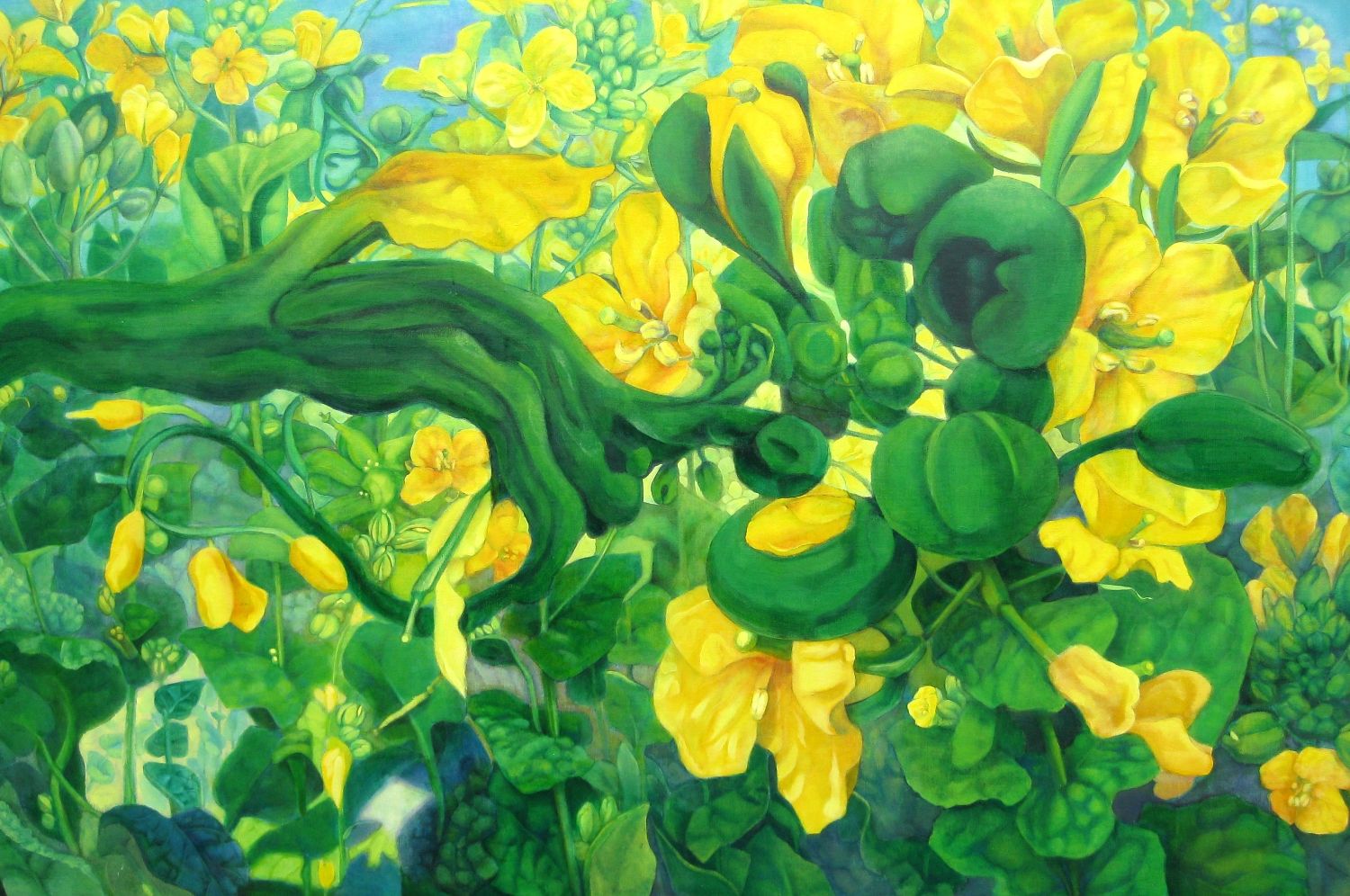 Image: Sleeping in the spring. Photo courtesy of Miho Libbey.
Libbey paints flowers as if she is seeing them again for the first time. She gives the petals room to reveal their full range of color, from saturated pinks and purples to delicate gradations of light and shadow.
But the flowers aren’t limited to the ones she remembers from Japan. After moving to the United States with her husband, she learned about the flowers in the landscapes around her, finding inspiration in their colors and forms. Others became reflections of her experience adjusting to a new country.
While living in South Carolina, she came across a white camellia growing in the woods.
“It looked isolated, and I felt connected to the flower,” Libbey said. “When I moved here, I felt so lonely because my English was not perfect and less Japanese people lived in the countryside at the time.”

Image: Tomadoi. Photo courtesy of Miho Libbey.
Motherhood also changed the way Libbey painted. She and her husband have two daughters, now 16 and 10. When she first moved to the United States, she had less time to go outdoors, sketch and paint.
The arrival of her first child changed the rhythm of her days. Some days it meant finding 15 minutes while something was boiling on the stove or dinner was cooking. Other days, she managed to set aside three uninterrupted hours. She also painted at night, after her family had gone to bed.
For Libbey, painting is a way of paying attention. A flower growing alone in the woods, a familiar field from childhood or a bouquet at the grocery store can become a starting point for examining a feeling.
“Each of us have this life and we all have our own stories of happiness, sadness, disappointment, grief and celebration,” Libbey said. “I use flowers to show those feelings and connect it to any kind of memory that blooms in my life.”◼︎
Libbey will give an artist talk at 2 p.m. Saturday, Nov. 14, at the gallery. “Life: What Blooms Within” will be on display at the Vine Arts Center until Nov. 28. The exhibit is open from 11 a.m. to 5 p.m. on Saturday and Sunday. The gallery is located at 2637 27th Ave. S., Minneapolis.
This activity is made possible by the voters of Minnesota through a grant from the Metropolitan Regional Arts Council, thanks to a legislative appropriation from the arts and cultural heritage fund. 
We can't do it without you.
Help keep independent arts journalism alive in the Twin Cities.
We can't do it without you.
Help keep independent arts journalism alive in the Twin Cities.