
Sea Change
Published October 21st, 2026 by Wayne Roosa
An Installation by Michal Sagar
Banner Image: Sea Change, graphite, charcoal, oil paint with wax, sand, and oil stick on paper, 40” x 60”, 2026.
A note from the Editor: Michal Sagar is one of those artists who gets to the heart of a feeling. Her last solo show, Sight Between, created an immersive world of light, suspension, and gesture, and the floating installation Rain of Ephemera still lives rent free in my head. Now Sagar is debuting a new show, Sea Change, on view at Form+Content Gallery beginning October 29th. In anticipation of the opening, artist and art historian Wayne Roosa walks us through the exhibition piece by piece. Enjoy the ride.
- Laura
◼︎ ◼︎ ◼︎ ◼︎ ◼︎
As you enter Michal Sagar’s installation, Sea Change, you are lifted by water. Not calm water but restless waters. Waves rolling, rising and falling, pulling you like a riptide or undercurrent into deeper places as you are swept down the corridor of this intimate gallery.
As an installation—not simply an exhibition of ocean pictures on the walls—Sea Change transforms the static gallery space into a metaphoric place where we become participants plunged into a world. There is a wildness here. An untamed turbulence rich in awe, danger, and beauty. As the title suggests, we are now at sea, surrounded by water in constant motion. There is no solid foreground or stable horizon to stand on. All is movement, change.
This gallery is long and narrow with each side wall divided into three bays between columns. In the first bay are groupings of multiple small drawings on each side of us. These are highly gestural depictions of ocean waves. Blues, aquas, whites, and blacks roll over each other in a shifting flow that is both beautiful and threatening. The broken brush strokes and pastel markings roil across the drawings’ support, which is not the solid ground of paper or canvas, but the enigmatic translucence of Dura-Lar. Even though these drawings are small (9” x 12”), the waves rising and falling in them feel enormous. They have weight and force which curls, collapses, then rises again. They seem capable of pulling us into their powerful vortexes.
They feel this way because Sagar has given us no stable ground, neither foreground, horizon or even island, to “stand” on and get our bearings. Instead, like Turner’s terrible sublime ocean storms or Leonardo’s notebook images of watery chaos in his Deluge drawings, we as viewers are in the water. Whether we are swimming or drowning is not clear. But both beauty and peril engulf us.
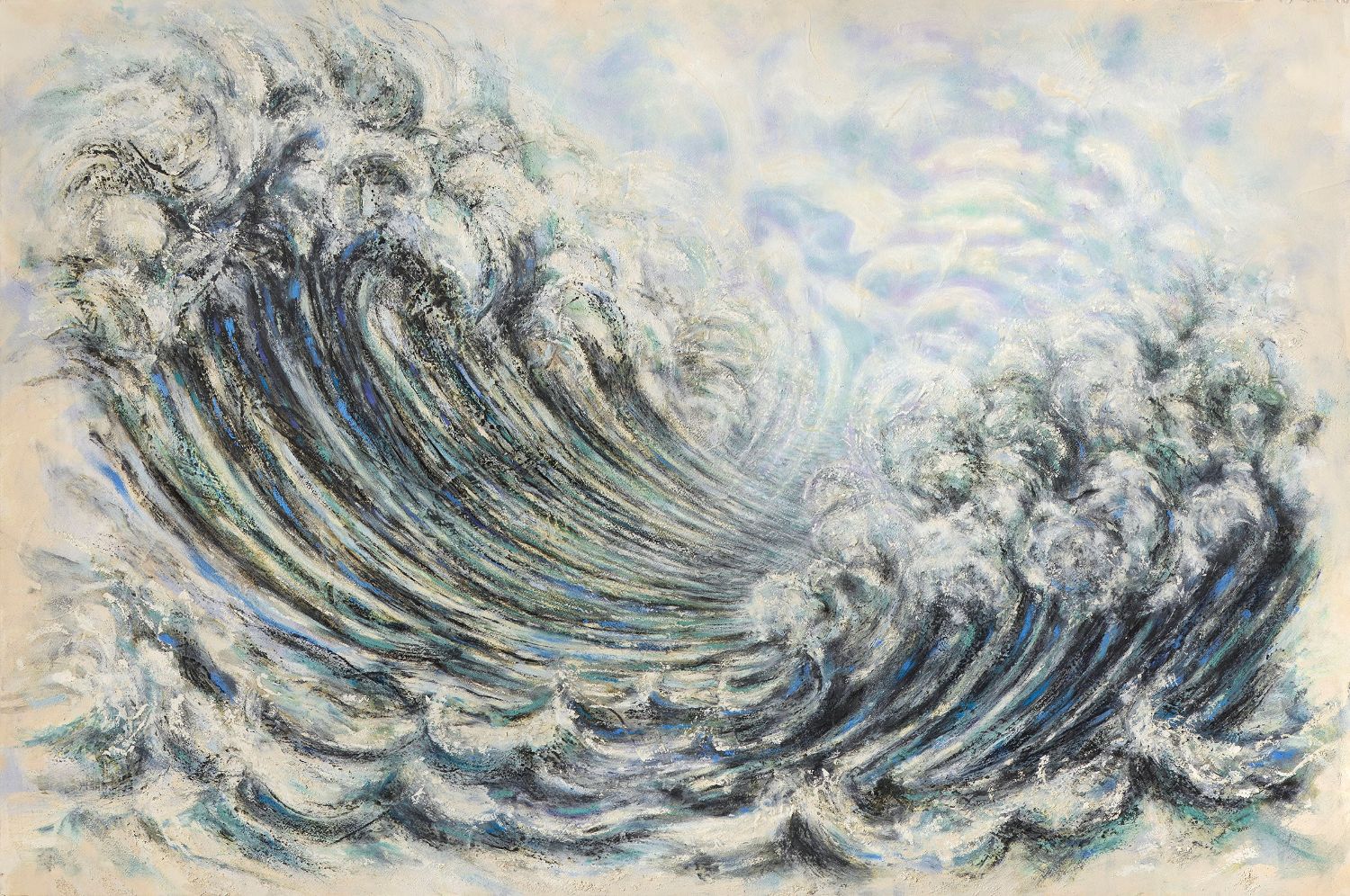
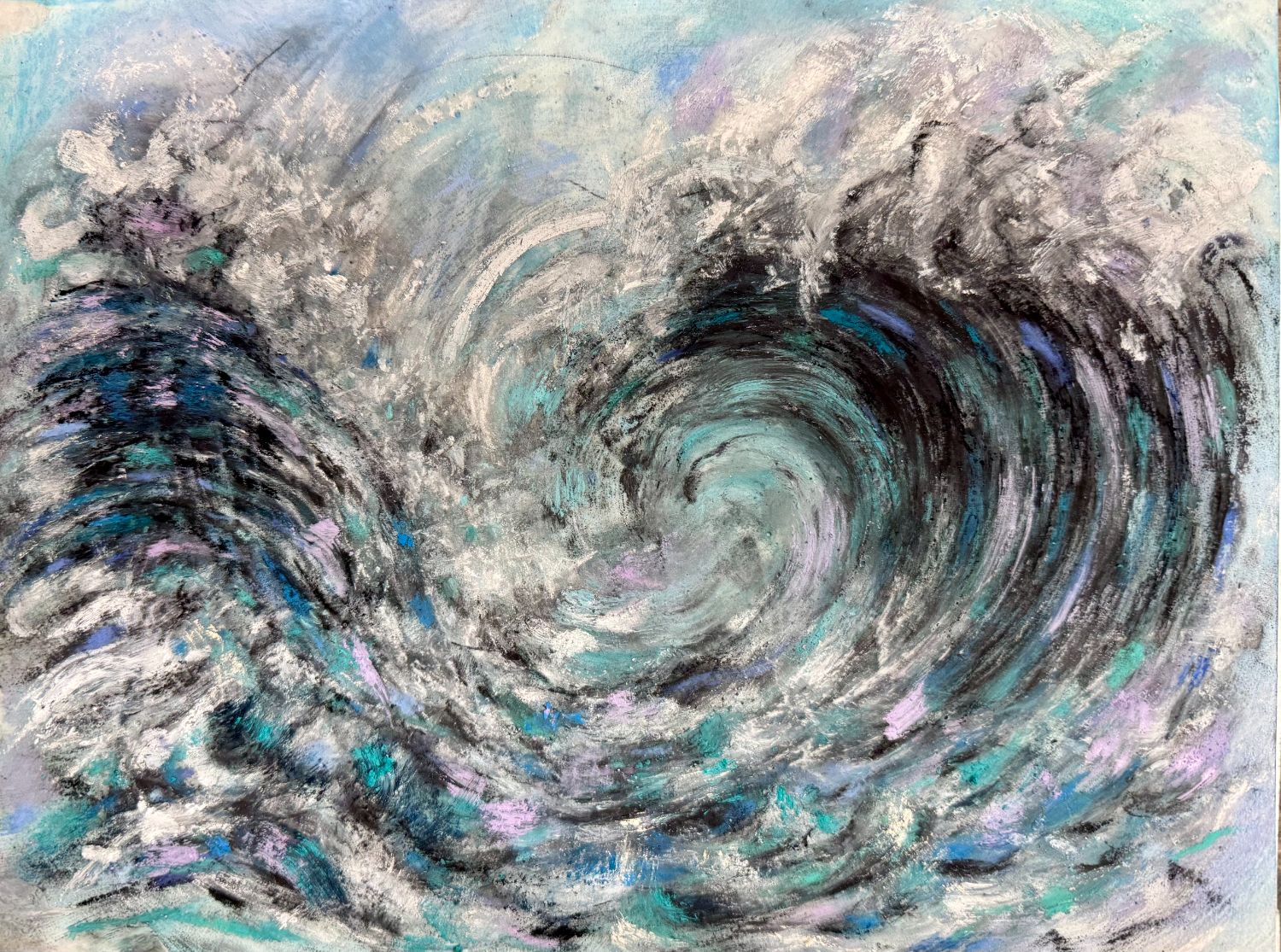 Top Image: Rogue Wave, graphite, charcoal, oil paint with wax, sand, and oil stick on paper, 40” x 60”, 2026. Bottom Image: Enter the Water (two of ten) graphite, charcoal, pastel, oil paint on Dura-Lar, 9” x 12”, 2026.
The remaining gallery bays flowing down each side are filled with very large 40” x 60” drawings of tempestuous waves. They too are executed in loose gestural marks that express the rippling quality of water. They too surge this way and that, seeming heavy and solid as walls of water, only to dissolve at their edges into the whiteness of the paper. The titles of these tell us in words what we are feeling in the tactile ferocity of drawing materials: “Rogue Wave,” “Cross Currents,” “Peak Wave,” “Sea Change.” As viewers, we move up close to the drawing surfaces, then back away to take in the whole image. This “in and out” viewing motion is partly about discovering the artistry, looking closely to understand how these dynamic images were made. But unconsciously, this close/far rhythm of positioning ourselves echoes the rocking motion of the waves. It is our bodily and psychic response as we seek a safe place to stand in the unpredictable presence of rogue waves and great troughs of sea changes.
The trouble is that we cannot back up to a safe distance. For running down the middle of the entire twenty-eight feet of the gallery nave is a mammoth artwork flowing over fifteen feet along that floor. It is the form of a great killer whale. To be precise, it is not a three-dimensional whale laying there as if beached. Rather, it is the shadow of a huge whale swimming stealthily along as if underneath our feet deep in the floor. As if passing silently under the watery world of wild waves where we flounder. Whether she is merely passing by or rising up the way a whale surfaces under one’s small boat in open water is impossible to say. Either way, she is elegant. And majestic. And ominous.
 Image: Shadow Encounter (details) reed, twine, and graphite on Dura-Lar, 5’2” x 6’ x 15’, 2026.
The artist has made this great shadow in layers of Dura-Lar painted heavily with clear gesso and graphite, giving it dimension and texture. The effect is a feeling of hushed power and mystery, suggesting a great primal creature dwelling in the underworld. The imagination immediately reaches for associations. Is this the great white sperm whale that haunted Ahab even as Ahab hunted it? Should we fear this creature? Or is this the breathtaking Leviathan in the Book of Job, a sign of such awe and magnificence that it overcame Job’s self-pity, bringing him comfort in his grief and pain? Either way, this shadow creature swims beneath the length of the gallery, untroubled by the fearsome waves, summoning us as viewers.
There is more here than shadow. Swirling up from its tail fins is a figure-like form made of woven reeds. It lifts out of the shadow into our space, coiling upwards into the air like a waterspout or a mythical spirit. The reeds from which it—one wants to say she—is woven are linear and gestural, echoing the gestural marks of the surrounding waters. She seems to ride the whale’s great fins like a sea nymph or emanation from the great creature gliding by. The overall physicality of the installation has carried us as viewers through the undulating troughs of waves on each side, along the giant shadow whale and her rider, towards the end wall where two more large wave drawings hang. But these are different. Both have pairs of young humans floating in the water.

 Images: Shadow Encounter (details), reed, twine, and graphite on Dura-Lar, 5’2” x 6’ x 15’, 2026.
Here the fury of the waves seems to be dying down. It is not clear if these children are safe, but they seem to belong to the water, for they are painted with the same gestural strokes as the water. They are distinct from the water and yet are woven into it as belonging there. In the one, New Waves, two young girls bob in the waves, playing, mouths laughing and eyes smiling at each other. The water is not calm, but neither is it threatening. In the other, See Life, the girl is older, perhaps even a mother. She holds a young boy in her lap, their arms around each other in comforting embrace. She protects him, her determined eyes looking into the distance, while his eyes directly engage ours. They are peaceful yet they probe us, asking us to understand something.
Between these drawings is a group of low-relief forms sculpted from handmade abaca paper and mounted to the wall. Their rough texture echoes the turbulence of the watery ripples. Longer inspection reveals the suggestion of faces. Like the reed-woven spirit in the gallery’s center, these too seem like spirits or the emanations of beings who dwell in water. They are enigmatic, seemingly female, and as such, they echo the mysterious presence of the reed-like figure riding the whale’s shadow. There is, of course, a direct unity between earth’s vast waters and living beings. The ocean is the biological source of life forms. We know this is where life first emerged and we know that our own temporal bodies are sixty percent water. We are literally water-conceived, water-born, and water-carried. But water is also metaphor of our lives as journey. Water is primal, mythic, archetypal. River, Stream, Boat, Vessel, and maybe whale shadow, all these poetically speak of life’s journey borne along in the currents.
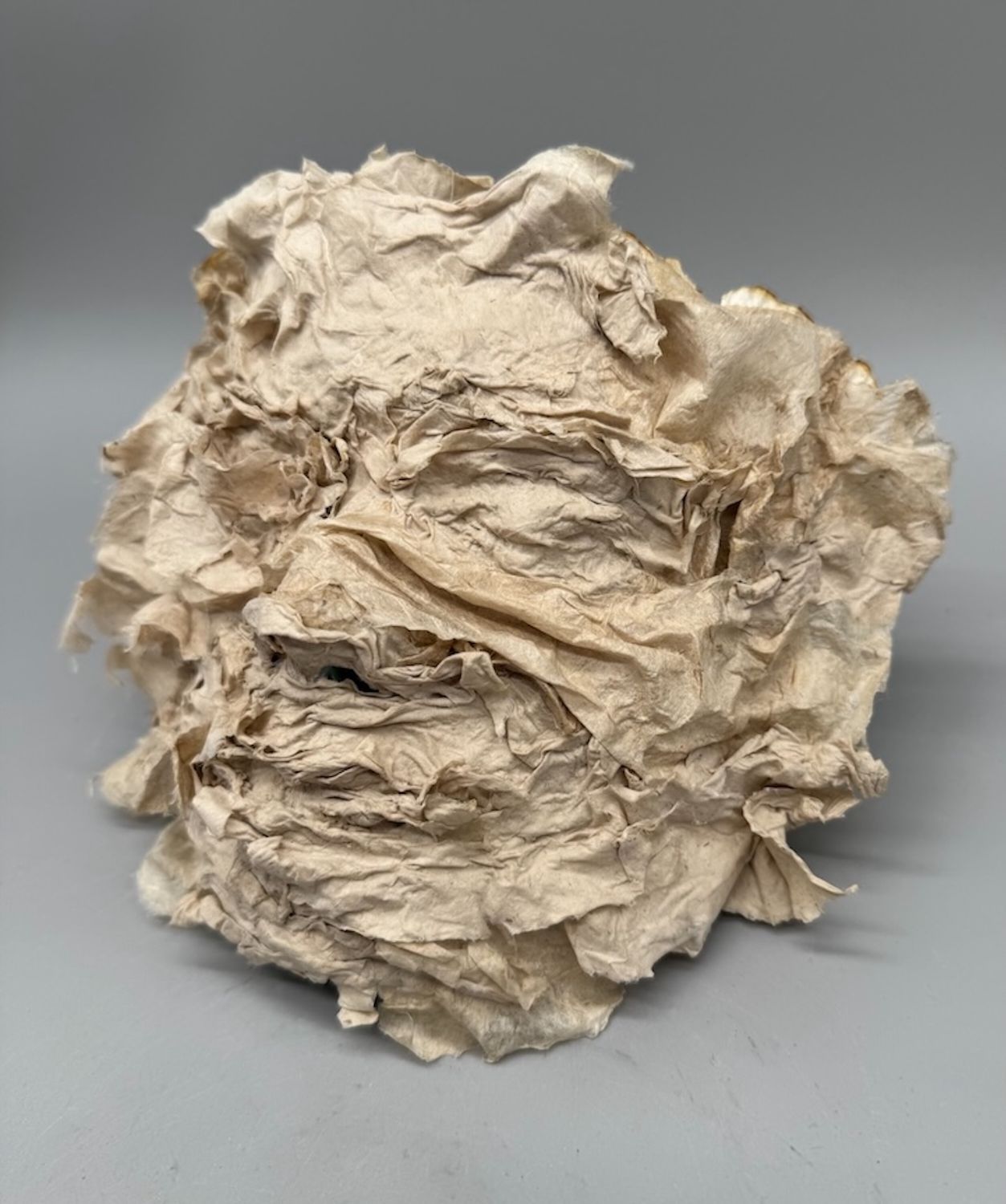 Image: See Change (one of seven), abaca paper, various sizes under 7” x 10”, 2026.
If we are most like the children bobbing in the water at the gallery’s end, we are least like the mysterious reed spirit riding the whale down the center of this space. She seems more an ur creature born of the whale, accompanying us through the beauty and violence of the water’s vast powers. Though she is delicate, there is nothing fragile about her. Her presence belongs more to the deep than the surface. There is indeed something mythic here. In spiritual literature, such as the Mishnah and Talmud, the presence of greater Being is often felt by vulnerable humans as a mysterious overshadowing, first causing fear but then often bringing blessing, protection, even comfort. After all, archetypal beings are never safe even when they are good.
This shadow whale with its whirling rider has that feel. Who is she? This is not Ahab’s killer whale. For Ahab’s killer soul—a thoroughly masculine soul—is not here. Is this more a caring, protective companion? A more feminine mother spirit? In conversation with the artist, Michal Sagar spoke of learning that the only species of female mammals known to experience menopause are human women and five species of toothed whales. In Evolution’s insistence upon survival by reproduction, the females of all other mammal species die shortly after their bodies cease to be fertile. But certain toothed whales and human women experience menopause and then live long lives beyond that. Is there a survival purpose in this? Who knows. But there is certainly a feeling of awe and wonder in it. For the grandmother whales are the ones with a deep, generational memory of where the best water currents are for following the salmon. In that wisdom, her silent presence swimming through the churning waters evokes a kind of caring in the face of danger. And of hope in the fear of primal waters.◼︎
Sea Change by Michal Sagar is on view at Form+Content Gallery, 210 2nd Street North, Suite #104, Minneapolis, MN 55401, from October 29 through December 5, 2026. The Opening Reception will take place Sunday, November 1, from 2-5 pm
 Image: Peak Wave, graphite, charcoal, oil paint with wax, sand, and oil stick on paper, 40” x 60”, 2026.
We can't do it without you.
Help keep independent arts journalism alive in the Twin Cities.
We can't do it without you.
Help keep independent arts journalism alive in the Twin Cities.