
Meximalismo adapted at Gallery Factory
Published September 1st, 2026 by William Gustavo Franklin Torres
30+ Latin American artists bring bold color and cultural pride to the runway
Back row, from left to right: Irving Rodriguez (Model & Artist); Noemi Rodriguez (Model & Artist); Izzy Leto (Model & Artist); Anissa Cavazos-Rodriguez (Model & Artist); Margarita Rodriguez (MODEL) & Noemi Rodriguez (Artist); Adriana Carmona (Model & Artist); Magdalena Corinne Kaluza (Model & Artist); Citlali Escobar (Model) & Dr. Karen Mary Davalos (Artist); Graciela DeAnda (Model & Artist); Alondra M. Garza (Model & Artist). Front row, left to right: Mikha "Mikhamik" Dominguez (Model & Artist); Sandra Houghton (Model) & Magdalena Corinne Kaluza (Artist); Alexa De Leon & Ana Rodriguez Sanchez (Models) & Ivonne Yáñez (Artist). Photo credit: NIGOJA Productions.
◼︎ ◼︎ ◼︎ ◼︎ ◼︎
A new show at NE Sculpture | Gallery Factory opened its doors this past August 15th to showcase the work of 30+ artists representing cultures from across Latin America, all inspired by Mexican maximalism. Curated by Silvana Agostoni and Maria Cristina Tavera, and presented by the artist-led organization Serpentina Arts, Meximalismo, “adapted to feature artists representing cultures from across Latin America through ‘more is more’ aesthetics, bold colors, rich textures, artisan craftsmanship, and popular culture symbols.” Meximalismo’s opening featured exquisite fashions by local Latinx artists in the indoor patio of the legendary Casket Arts Building in Minneapolis. The catwalk event and gallery exhibit re-championed Latin American maximalism as a vibrant outlet for individuality.
Meximalismo (also Méximalismo), maximalism in Mexico, is a specific movement that builds on Mexico’s singular collective identity. The word was coined in 2023 by Mexican stylist Dixy Rodríguez, “as an aesthetic that claims excess, origin, and pride” (como una estética que reivindica el exceso, el origen y el orgullo). In a 2025 interview with The New York Times Style Magazine, Rodríguez explains,
Everything started in 2023, when I moved to Toronto. I started to make independent editorials with a kitsch and an eclectic style, but with that Mexican essence. I didn’t have a name then. I used to call it Mexican style, although I felt it was not sufficient. Until I understood that it wasn’t just about kitsch, but about identity. Then I called it Meximalismo. At the beginning it was a personal manifesto, but later I realized it wasn’t only mine, but also of all of us who see “too much Mexican” as cultural pride, not as a trend.
 Image: Self-Portrait (Composition 352) by Mikha "Mikhamik" Dominguez, mixed media sculpture. Photo credit: NIGOJA Productions.
A mixed media sculptural installation titled Self-Portrait (Composition 352) by Mikha "Mikhamik" Dominguez features two vibrant purple and blue woven structures or boxes along with a crown of fresh and dried flowers hanging from the ceiling of the gallery. According to the artist, “the two boxes represent the mind and the body as a whole”. A Queer and excessive visual artist born in Venezuela, Dominguez is a master of color and pattern mixing through which they explore gender, culture, and mental health. For the catwalk walk, "Mikhamik" modeled an elaborate, multi-part design with golden accessories titled El Santo de Trapo. The dress reimagined religious traditional iconography through the presence of a queer body and narrative while also representing protest and protection.
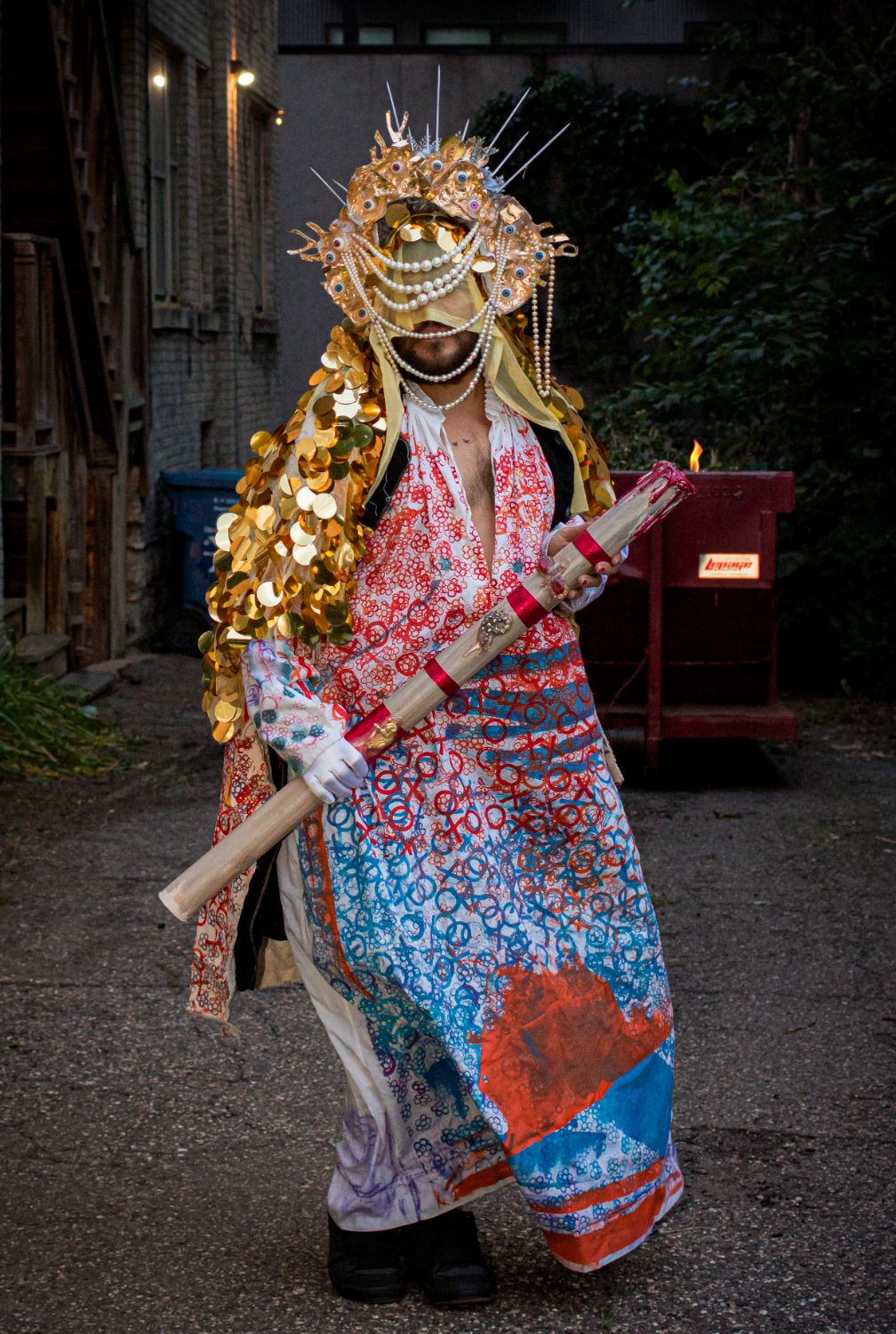 Image: EL SANTO DE TRAPO, design by Mikha "Mikhamik" Dominguez.
The red tulle gown worn by Mexican artist Graciela DeAnda had no match raising hearts during the fashion show; a striking, haute-couture-evoking design with a golden heart pendant and decorative crosses. DeAnda also wore a matching red floral headpiece and strong red lipstick makeup. Her confidence and pride during the catwalk walk was high on energy.
Alfi’s Crown is the headpiece of Little Pieces of Time, a collective artwork first showcased at the landmark 2024 exhibit Latina and Latinx MN: Re/claiming Space in Times of Change. The headpiece was worn during the inauguration by Adriana Gordillo, “it includes over 150 handmade paper ferns and flowers, along with oversized pins that explore the natural and sewing symbols the artist associates with memories of the women in her family in her native Colombia.” Alongside the headpiece, Gordillo wore a necklace by designer Diana Góngora.
A diptych rooted in Latin American Neo-Baroque and contemporary Meximalism by Colombian artist Sandra Lucía Castañeda combines photography with painterly intervention. “A fractured reflection replaces recognizable identity, inviting us into the fragile space where the self is continually rewritten.” Mujer palimpsesto y su espejo (Palimpsest Woman and Her Mirror) is a skillful and well-crafted reinterpretation of baroque aesthetics and Meximalismo’s visual abundance.
 Image: Mujer palimpsesto y su espejo (Palimpsest Woman and Her Mirror), diptych by Sandra Lucía Castañeda. Photo: courtesy of the artist.
Meximalismo is also Christopher Alday, Daniel Acevedo, Adriana Carmona, Angela Carmona, Anissa Cavazos-Rodriguez, Samantha Noemi Cortez, Karen Mary Davalos, Luis Fitch, Alondra M. Garza, Cándida González, Hedgiee, Magdalena Corinne Kaluza, Izzy Leto, Steven James Mayorga, Catheryne Molina, dougie padilla, Patrick Price, Natalia Rocafuerte, Xavier Robles Armas, Irving Rodriguez-Calderon, Noemi Rodriguez-Torres, Xavier Tavera, Sofia Vasquez, Jerry Vigil & Ivonne Yáñez.
Maximalism manifests in global cultures, with its visual roots stretching back centuries. Fundamentally, it has developed almost as a human/cultural impulse in different parts of the world. Maximalism today –understood as a formal aesthetic and modern counter-movement– can be found all over Latin American cultures (e.g. Mexico, Brazil, and Chile), in West Africa, India, the Middle East, and China. In many instances, Maximalism is tied to the rich indigenous history, folk art, and tactile craft of these and other cultures. It needs to be said that Maximalism often draws inspiration from the ever-growing multiculturalism of the world.
It was American art critic and historian Robert Pincus-Witten (1935-2018) who introduced the concept of maximalism in the late 1970s in the context of a rising number of Neo-Expressionist artists who revolted against the austerity, sometimes referred as “lack of human touch”, of minimalist and post-minimalist art. The counter-term to Minimalism was just not a vague designation, but rather a conscious and real-time pushback against to what many thought of as a sterile visual and emotional environment (Pincus-Witten’s 1983 book Entries (Maximalism): Art at the Turn of the Decade, and the 1987 follow-up Postminimalism into Maximalism: American Art, 1966-1986, trace the shift into the rich and crowded art (aka, aesthetics of excess) produced by some artists in the United States and beyond).◼︎
Meximalismo will be on display at NE Sculpture | Gallery Factory until September 12. The exhibition is open Thursday through Saturday 12-5pm or by appointment. Gallery Factory is located at 1720 Northeast Madison Street #14 in Minneapolis. Follow NE Sculpture | Gallery Factory on IG here.
This activity is made possible by the voters of Minnesota through a grant from the Metropolitan Regional Arts Council, thanks to a legislative appropriation from the arts and cultural heritage fund. 
We can't do it without you.
Help keep independent arts journalism alive in the Twin Cities.
We can't do it without you.
Help keep independent arts journalism alive in the Twin Cities.