
2024 McKnight Visual Artist Fellow: Rachel Breen
Published April 23rd, 2026 by Laura Laptsevitch
Through textiles, archives, and activism, Rachel Breen confronts the histories and ongoing realities of garment labor, asking what it means to witness, remember, and repair.
 Article made possible thanks to the
 McKnight Visual Artist Fellowship Program. Administered by the Minneapolis College of Art and Design.

Banner Image: Shroud, installation view, 2018. Image courtesy of the artist.
◼︎ ◼︎ ◼︎ ◼︎ ◼︎
This is the fourth in a series of articles profiling the six distinguished artists chosen as 2024 McKnight Fellows in Visual Arts, a grant program for mid-career artists in Minnesota that is administered by the Minneapolis College of Art and Design. The 2024 cohort includes Rachel Breen, Sophia Chai, Dahn Gim, Alison Hiltner, R. Yun Matea, and Chris Rackley.
Their two-year fellowship will culminate this spring with a group show, What Holds and What Breaks, opening May 7, 6–8pm and running through June 7 at the Minnesota Museum of American Art in St. Paul.
◼︎ ◼︎ ◼︎ ◼︎ ◼︎
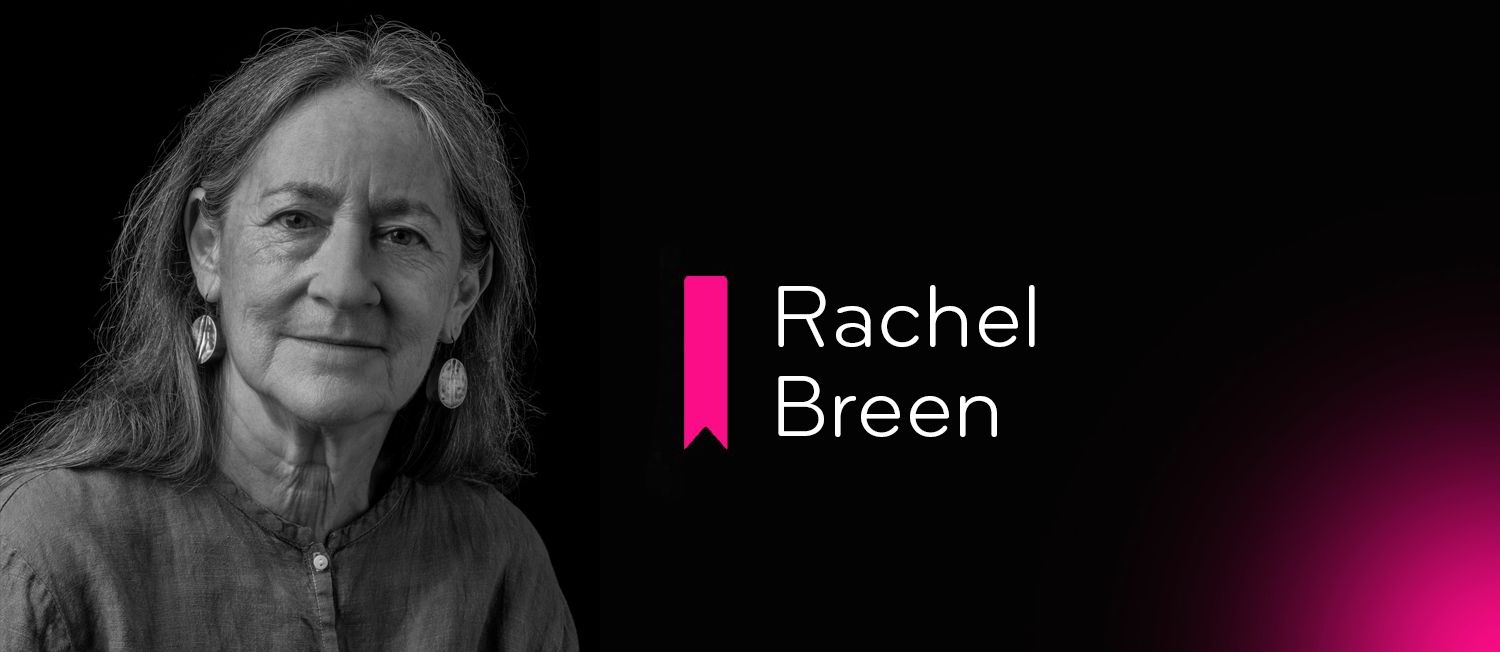
Photo by Rik Sferra, courtesy of MCAD.
It’s powerful to encounter an artist whose message has remained steady over time. Some artists begin with materials, pushing and testing what an object can do. I think of Cai Guo-Qiang’s gunpowder drawings, where fuses and loose explosives are arranged across surfaces and ignited, leaving behind smoke and scorch marks that form the image. The work begins with a question: what can these materials do?
Other artists begin somewhere less tangible. They are led by an idea—a question, a critique, something they are trying to articulate. The material follows, shaped in service of that intention. This is often the terrain of conceptual practices, where form shifts but the underlying concern remains precise. Anthony Akinbola’s durag-based works, for example, use culturally specific materials that operate simultaneously as object and metaphor.
When artists are able to hold both, push the limits of material while staying grounded in a clear conceptual drive, the result can feel like a meeting point between art and lived experience.
This dual commitment is central to the work of Rachel Breen. Breen’s work is research based and activist oriented. Her recent body of work, Banners for the Commons, brings together textile assemblage, labor history, and environmental critique. The banners are constructed from used garments, reconfigured into large-scale forms that echo the visual language of early twentieth-century labor movements.

Installation view, Banner for the Commons and Speculative Garment works.
Banners, highly charged objects of the early 1900's, are reimagined aesthetically and materially with used garments.
While touching on heavy topics of overconsumption and environmental disarray, Breen manages to create something playful. Their colors, the red and gold, mirror the red and gold of the original International Ladies Garment Workers Union banners, made by workers of the vanguard ILGW Union. The colors also represent alarm surrounding working conditions of garment workers and warning about the climate crisis.
Breen’s path to this work was not linear. She earned her undergraduate degree in Political Economy from The Evergreen State College and spent two decades working as a community organizer and grant writer. Her work included political campaigns across the country and the co-founding of the Twin Cities nonprofit Jewish Community Action. Over time, she began to question the durability of political change. Legislative wins, she observed, were often temporary—subject to reversal, erosion, or neglect. That realization prompted a shift in thinking. Art, she began to see, could operate differently: not by securing fixed outcomes, but by shaping perception, sustaining attention, and opening space for inquiry.
That shift led her to graduate school at the University of Minnesota, where her studio practice began.
The Work
Breen was not always a textile artist. In fact, the sewing machine started out as more or less an accident. When it came time for graduate school, Rachel bought a sewing machine at a garage sale for $3.
“I started experimenting,” she says, “I was sewing fabric to paper, and I wasn't even thinking of it as a drawing tool. It was just a toy.” At that point, she needed equipment to fill her studio, a huge space with 24 hour access that she would use for 3 years. “One day, I was sewing, and I ran out of thread, and I noticed the hole that the needle made in the paper.” One thing led to another and Rachel developed what has now become her signature.
I noticed this technique in a handful of drawings. Back in 2011, Breen used pierced holes as marks on paper in Let’s Not Leave It to Chance, a series of multidisciplinary drawings inspired by the cultivation and preservation of heirloom seeds.


Top: Let's Not Leave It To Chance, 2011. Bottom: Let's Not Leave It To Chance, detail view
A second big development was the making of stencils. Breen used the paper she had worked using the unthreaded sewing machine and used it as a stencil. Once she punched the paper and the design was complete, Breen shook powdered charcoal through the stencil onto fresh paper.
She also used these stencils in wall drawings, including 7 Meals (2010), an installation addressing hunger and the stark disparity between abundance and scarcity. Working with a sewing machine embeds ideas of repair into her work.


Top: 7 Meals, 2010, installation view. 7 Meals, detail
Breen expands the convention of drawing, stumbling upon using the pierced holes as marks on paper. Using stencils made of pierced paper in the chalk dust drawings begins the commitment to telling a different story with materials. The story continued when Rachel began to incorporate garments into her work.
The Shift
A significant turning point occurred in 2013 following the Rana Plaza factory collapse in Bangladesh, which killed more than 1,100 garment workers.
At the time, Breen was working in a multi-story studio building with her sewing machine. “I just remember thinking about what would it feel like if the floor just fell out” she said “I started to think about it, and so I felt connected to it.”
Breen's work relies heavily on research. She decided to go to Bangladesh and interview survivors.
While in Dhaka, Breen met with a Union activist who told her about a public cemetery, and suggested that she go see it. There are more than 100 bodies that were buried that only have been identified by their DNA. More than 100 bodies have never been claimed by families. It could mean families didn’t have enough money to travel to get the bodies or that multiple generations of a family were wiped out.
In Dhaka, Breen started thinking about the dead garment workers in a tragedy that occurred 100 years earlier, the Triangle Shirtwaist Factory Fire in New York City in 1911. “In the news articles that you see from that disaster, you see dead bodies lying on sidewalks.” Breen said. “147 people died in that disaster, many jumped to their death or burned to death.”
The owners had locked the doors to the factory because they were afraid the workers would steal. So when the fire broke out, the workers could not escape.
In addition to working in a similar industrial building with her sewing machine, Breen felt another layer of connection coming from a family of immigrants. “Most of the people who died were Jewish immigrants, my family came to this country at that time.”
The fire led to significant safety laws in American factories. When the Rana Plaza Factory collapsed, Rachel wondered how something like this could happen more than 100 years later. “Shroud was about the number of people who died in the triangle, shirtwaist Factory fire and the Rana Plaza Factory collapse combined. So it was a symbol of how garment workers have been exploited across geographic borders and throughout history.”


Top Shroud, Installation view, 2018 Bottom Shroud detail view
Breen continued to build this line of inquiry in works such as Piece·work, which assembles garment fragments into installations that emphasize repetition and labor, and How to Dismantle a System, which examines blue jeans as a global commodity shaped by extraction and environmental harm.
In 2020, she created Who Made Your Sleeves?, wall drawings in powdered charcoal that foreground the invisible labor embedded in everyday clothing. Garment workers, she notes, often produce hundreds of pieces per day under unsafe conditions and for wages that do not meet basic living standards.

Who Made Your Sleeves? Installation view. Powdered charcoal, 2020
This brings Rachel to her most recent work, Banners for the Commons. Rachel went to Cornell University’s Kheel Center, the largest labor archive in the United States, to research the Triangle Shirtwaist Factory fire and the formation of the International Ladies’ Garment Workers’ Union.
At the archive, she began with ILGWU founding documents and ephemera, using them as a starting point without knowing exactly what she would find. Archivists then asked if she wanted to see the banners. Unsure at first what they meant, she watched as they brought them up from deep storage. The fragile banners required gloves and careful handling, allowing them to be viewed but not held. The encounter became an unexpected entry point that opened the research in a new direction.
 Banners for the Commons, installation view in studio
 “Reverberations” in Rachel’s studio
In her studio, Breen is also developing new works she calls “reverberations.”
She punctures paper and hand-stitches threads pulled from old garments into the surface. The threads retain traces of their previous lives, color, wear, texture.
“Even when it’s not in the clothes anymore,” she says, “it still has the memory of what it was like when it was in the clothes.”
She uses the term "reverberations" to describe more than material residue. It also refers to consequences, the ongoing effects of garment production on workers and environments: chemical runoff into water systems, repetitive strain injuries, and the long-term conditions of labor that remain after the garment leaves the factory.

The thread for Reverberations in Rachel’s studio.
It's sobering to sit with the scale of harm embedded in the garment industry. But Breen’s work also insists on another possibility: that attention itself can be a form of repair. Across Banners for the Commons, Piece·work, How to Dismantle a System, and Shroud, she returns to the same question—not how to resolve these histories, but how to stay with them, together, long enough to imagine something otherwise. ◼︎
To see more of Rachel Breen's work, visit her website rachelbreenart.com or follow her on Instagram @rbbreen.
We can't do it without you.
Help keep independent arts journalism alive in the Twin Cities.
We can't do it without you.
Help keep independent arts journalism alive in the Twin Cities.