
2024 McKnight Visual Artist Fellow: Chris Rackley
Published April 1st, 2026 by Laura Laptsevitch
Scale, Storytelling, and the Quiet Labor of Care in Chris Rackley’s Mall Worlds
 Article made possible thanks to the
 McKnight Visual Artist Fellowship Program. Administered by the Minneapolis College of Art and Design.

Banner Image: detail of Sales Floor. Image courtesy of Laura Laptsevitch.
◼︎ ◼︎ ◼︎ ◼︎ ◼︎
This is the third in a series of articles profiling the six distinguished artists chosen as 2024 McKnight Fellows in Visual Arts, a grant program for mid-career artists in Minnesota that is administered by the Minneapolis College of Art and Design. The 2024 cohort includes Rachel Breen, Sophia Chai, Dahn Gim, Alison Hiltner, R. Yun Matea, and Chris Rackley.
Their two-year fellowship will culminate this spring with a group show, What Holds and What Breaks, opening May 7, 6–8pm and running through June 7 at the Minnesota Museum of American Art in St. Paul.
◼︎ ◼︎ ◼︎ ◼︎ ◼︎

Photo by Rik Sferra, courtesy of MCAD.
Chris has a knack for telling stories. As I entered his studio and listened to his process, I realized why No Place Like This garnered such an emotional response, particularly from parents. It’s emblematic of millennial youth and boyhood imagination, but most importantly, it’s a love letter to single fathers.
This sensitivity to memory and storytelling is rooted in Chris’s upbringing. Chris, like many artists in 2026, works across disciplines. He is a multimedia artist who works in sculpture, digital media, and analog photography. His work centers around a childhood spent in suburban shopping malls. Relocated multiple times across the country in South Carolina and Georgia because of his father's shoe company, Chris spent much of his childhood in the back of the stockrooms of stores his father managed.
He takes his memories from childhood and turns them into scale models through a combination of research (mostly old photographs, Google Maps, and even some YouTube videos) to actualize the memory in physical form. The once introverted child who spent much of his early years drawing in back rooms now works from an in-home-studio; a repurposed office space downstairs and a bedroom-turned-editing bay upstairs, just about 30 minutes outside the twin cities.

 Images: Top left, photograph of The Portal, 2023. Top Right, Going Outside To Play while Matt Throws Out Empty Boxes, 2023. Photograph by Laura Laptsevitch. Bottom: Installation view of The Portal, 2023, and Going Outside To Play while Matt Throws Out Empty Boxes, 2023
His most recent show, No Place Like This, presents handmade, scale models of the many shopping malls he once called home. The one Chris showed me first, The Portal (2023) is a scale model of Gwinnett Place Mall in Duluth, Georgia.
I sat down with Chris at his home studio, where we discussed the stories behind his tiny Mall sculptures, complete with a touch of millennial nostalgia all over a Caribou mocha and cold-pressed iced coffee.
Home Is Where the Mall Is
I wondered how Chris stumbled upon this topic. The project started organically. Back in 2019, Chris received the 2018-2019 Verge Fellowship and began exploring themes of identity.
In There Is No Conflict, he filmed himself in Darth Vader and Luke Skywalker costumes, sketching the still images of himself dressed as the characters. He realized that the work he was trying to make was really about his father. “I had avoided it for years.” He shared. “I never wanted to be too autobiographical.” Though there was hesitation to make the work that might be read as too literal, he leaned in and embraced the literal-ness. What started as a one time exercise turned into a series of Chris’s most comprehensive body of work. In his studio, I was surrounded by tiny shelves, tiny shoe boxes, and shopping mall dioramas.
The first iteration of the shoe store was Does Your Shoe Have a Boy Inside? a piece that was on view at Rochester Art Center back in 2019. The installation included three related artworks: Stockroom (Greenscreen), Memory Shelves, and Shoebox Theatre.

 Top Image: Memory shelves, 2019. Bottom Image: Detail of Memory Shelves. Photograph by Laura Laptsevitch.
I got a chance to see Memory Shelves in Chris’s studio. I peeked into a circular cut out of the shoebox, it has a hidden diorama inside. It’s made with wood, foam, cardstock, inkjet prints, LED lights, electrical wiring, polystyrene, acrylic paint, mirrors, aluminum and rubber grommets.
Of all the shoe-store-related works, Sales Floor is my favorite. Made a few years later in 2023, Sales Floor is an open diorama of the shoe store sales floor, made with wood, paper, inkjet print, foam, polystyrene, cloth, and paint. Below the chairs are tiny drawings of Luke Skywalker and Darth Vader–both repurposed drawings Chris made when he was 12 years old.
I wondered about the drawings. “Were these done by hand?” I ask. “I scanned them and shrunk them down to the scale of this model.” I squint to get a better look. “It's one-eighth scale.” The drawings belonged to Chris’ father, who saved all his son’s drawings. “That's partly what this project started as,” Chris shared, “a recognition that we didn't have photographic documentation, but he kept all of my artwork.” Chris did not have many pictures of himself, outside of birthdays or holidays. Even though Chris’ dad was a quiet and serious type, and didn’t take many pictures, he still saved all his son’s drawings.

Left Image: Sales Floor. Right Image: Detail of Sales Floor. Both photographs by Laura Laptsevitch.
Chris leaned on his father for help collecting memories. After a few years of asking very specific questions to his father, "How big was it? How many were there? Where was that?” stories came back.
Among these stories, one stood out in particular. After Chris’ father closed the store for the night, it came time to deposit the cash in the bank box at the mall. His dad took the bag to this big silver box, opened the drawer, and dropped it in. The moment he closed the door, he realized he'd dropped his car keys in with it. “He still had the store keys,” Chris said. “So we went back to the store. He unlocked the gate and closed it behind us.” Chris smiled. “We slept there overnight. He made beds out of women's handbags.” It was a warm and magical memory that felt like Night at the Museum for a young kid.
Chris also shared a memory of finding a bird in the back room. Many shenanigans occurred, including filming short films on a camcorder while his father was working.
The Process
Much of what Chris does while making these miniatures is reconciling gaps in memory as he works. “Memory always lives in these disconnected loops.” he says, “You can't watch it like a film, it's like little boomerangs. Things at different scales feel like they address the gaps between memories.” This was the case for a piece on his worktable, one I couldn't stop looking at. It's a model of a red stockroom handcart used in his father's shoe store. I ask how the process worked. “It starts as a drawing from memory.” He said, “Then I try to find the actual measurements and turn that into an Illustrator file.” What follows is a lot of testing and redesigning until the pieces finally fit. The amount of math, building, rebuilding, and starting over to get the cart just right are details one would not notice or expect. I say, “You’re essentially a product designer.”
 Image: Stockroom handcart. Photograph by Laura Laptsevitch.
Arguably, the most difficult piece to make was his scale model of the Duluth, Georgia mall. Chris had not been there for years and was working mostly on memory. I was surprised to learn that the scale model of Gwinnett Place Mall was pieced together through video recovered from YouTube, TikTok, and Instagram. “I had one blurry photograph of this entrance," he said. "There are dead mall enthusiasts who just go out with their phones and cameras and do walkthroughs of these places. I'd look at those images and figure out scale based on something in the photo I knew the size of, a door, for example, and then extrapolate everything else.”
Even though Chris is focused on details like physical measurements, he still wants to work to feel real to him. “I needed it to exist.” He continued, “It felt like an excavation, using someone else's documentation to rebuild something.”
Digital Media
We moved on from the downstairs space and headed up to the second floor. Chris showed me his editing bay, a room where he sketches, brainstorms, and edits his photos and videos. I flipped through his sketchbook.
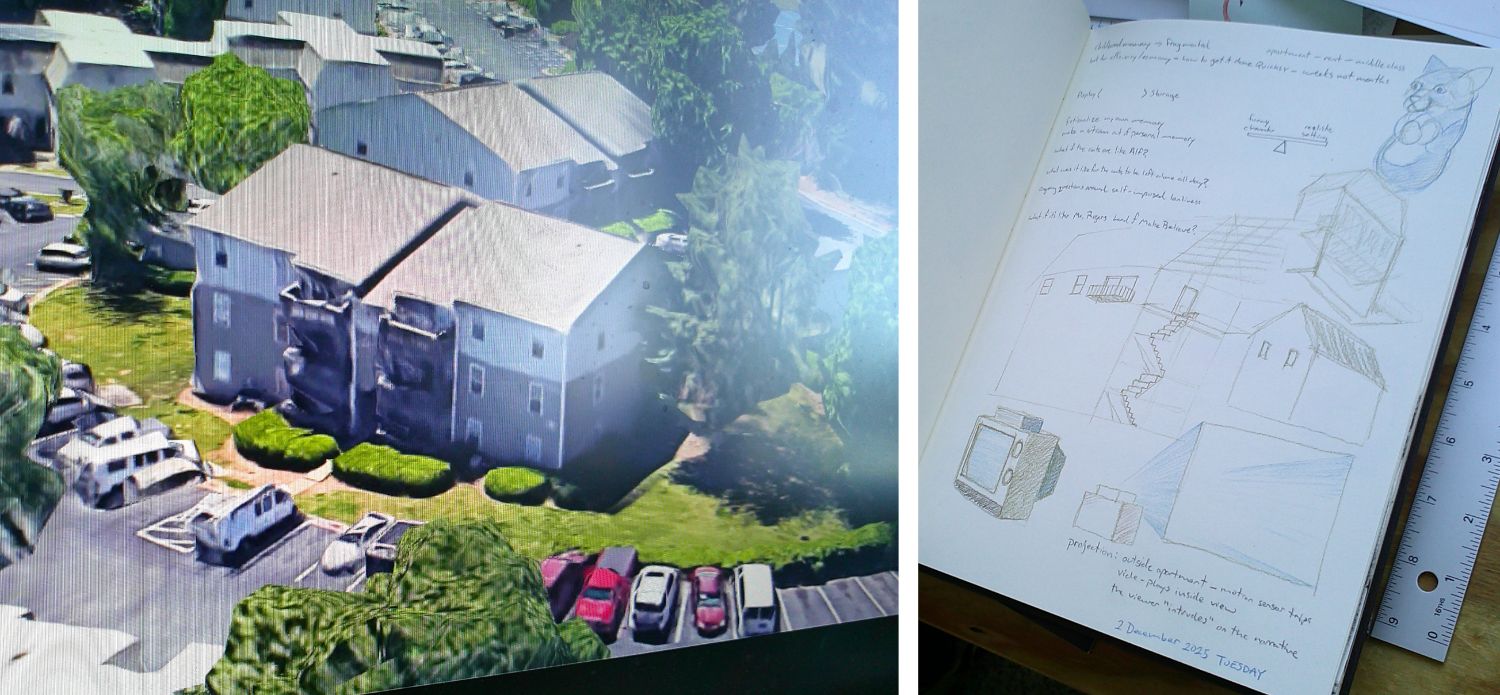 Left Image: Google Maps in Chris Rackley's studio. Right Image: Chris Rackley's sketch book. Both photographs by Laura Laptsevitch.
In an old apartment, Chris remembers a cat getting trapped inside the walls. She was pregnant, and her kittens were born there, hidden within the building itself. He recalls the effort his family put into trying to rescue them—an ordeal that, somehow, happened more than once. Later, Chris pulled up the dimensions of that apartment on Google Maps, tracing the space from memory. He showed me his sketchbook, filled with notes and drawings, working carefully to reconstruct the scene.
In addition to the Mac computer, Chris shows me new camera equipment that was funded by the McKnight Fellowship. Because of this new equipment, he was able to edit the videos you see in his piece, Mall Hours (2025), a two-channel, synchronized HD video, color, sound, 10:00 minutes, looped.
The McKnight
“Speaking of the McKnight," I ask, "where were you when you found out you’d gotten it?” Turns out he called up Niki Havekost for emotional support, an artist also based in Rochester. “We're all a tight group there, always helping each other install shows, document work, carry things, build things.” He shared, “I was so nervous waiting to hear. You either get a phone call or an email. So I went over to Niki's studio, and we just drew together while we waited.” He cracked a smile. “That's where I found out. There was some screaming.”
This was Chris’s third time applying for the prestigious fellowship. “Everybody applies. And everybody should.” He says, “There's no reason not to. One of the great things about McKnight is that they give feedback to everyone, whether you get it or not.” He continues, “They won't tell you who said what, but they'll tell you very specifically what was discussed.” Occasionally, the feedback involved an unclear application or a poor connection between the work and the artist statement. Other times, the feedback is that there are only so many openings. “Sometimes what you learn from the feedback is that there was nothing you could have done better”, Chris shares, “there are more deserving artists than there are spots.”
You have to be simultaneously tough and breezy to stay sane as an artist. Chris does it by making it fun. “You have to develop a tough skin, a sense of humor, and treat it like a game. My friend Niki and I actually had a competition one year to see who could get the most rejections.” I laugh. “Who won?” I asked. “Niki." He smiled. "So I had to buy the nachos.”
 Image: Photograph of Going Outside To Play while Matt Throws Out Empty Boxes, 2023.
It’s worth pausing to ask why this work lands the way it does. The smallness really resonates with people. The photo for his show, with his finger showing the scale of the mall, was a big hit. I lean in and ask why. “What do you think makes the hand images so compelling?” He paused. “I think it's about layers of removal. We live in a world where we're so removed from reality, a picture of a picture of a thing, then AI, all these layers away from the actual human experience. When you see the hand, it collapses that. It tells the story really quickly, without words. It makes clear that these are real, handmade, physical objects. And it shows the scale in a way nothing else does.”
The dead mall has become its own kind of cultural genre in the years since retail began to decline. Not long ago, during the pandemic, malls became places to walk simply because there was nowhere else to go. In Minnesota, Burnsville Center and Maplewood Mall have seen fewer visitors, while the Mall of America is still holding on. Besides the strong nostalgia, 80s and 90s nerd culture, CDs, punk bands, grunge fashion, and the scary but inevitable turn of the millennium, this work involved viewing something objectively.
Viewing from up high, with an aerial perspective, gets to this idea of being displaced, being an outsider. Viewing The Portal (2023), we are on the outside looking in. Much of Chris’ work involved viewing something from the outside, which ironically, is what we experience at shopping malls. The exercise here is to learn to look objectively, to be curious, and to reflect. We need these layers of removal in a world that is so removed from reality.◼︎
Visit Chris Rackley's website at www.chrisrackley.com or follow him on Instagram @rackleystudio.

We can't do it without you.
Help keep independent arts journalism alive in the Twin Cities.
We can't do it without you.
Help keep independent arts journalism alive in the Twin Cities.