
Modern Art and Politics in Germany 1910-1945: political art from the first half of the 20th century
Published March 26th, 2026 by William Gustavo Franklin Torres
German Art Across War, Ideology, and Exile at the Minneapolis Institute of Art
Banner Image: Entrance to Modern Art and Politics in Germany 1910-1945. Courtesy of William G. Franklin T.
◼︎ ◼︎ ◼︎ ◼︎ ◼︎
Modern Art and Politics in Germany 1910–1945: Masterworks from the Neue Nationalgalerie, Berlin, is on its second stop in the US at the Minneapolis Institute of Art, its first stop was at the Kimbell Art Museum in Texas last year. The exhibition comprises seventy plus works (many shown in the 1937 Nazi anti-modern art exhibition Degenerate Art) from the collection of the Neue Nationalgalerie. It is organized by the Neue Nationalgalerie, Berlin, in cooperation with Mia, making it the first time works from the Neue Nationalgalerie collection travel to the US.
At the Kimbell Art Museum in 2025, the exhibition received immediate praise for its “haunting" quality, for capturing how artists were persecuted, imprisoned, exiled, or forced to work in secret. A review by Judith H. Dobrzynski, a contributor for the Wall Street Journal, praised it for its timely relevance, it "unavoidably prompts reflection on political developments around the world today". The takeaways of Modern Art and Politics in Germany 1910–1945: Masterworks from the Neue Nationalgalerie, Berlin are many. This makes the exhibition not easy to summarize in spite of its straightforward title and well curated thematic approach.

Sonja, 1928, Christian Schad, oil on canvas. Photo courtesy of William G. Franklin T.
I went to see the exhibit twice at Mia (I’m sure many others will do too), giving myself enough time to discover missed details, to deepen my understanding –it takes time to absorb it. The years 1910-1945 were some of the most turbulent in European history: two devastating world wars, the collapse of major empires, the rise of totalitarian ideologies (fascism, Nazicism, Stalinism), the Great Depression (it hit Europe as well), the Holocaust, the death and destruction. To focus purely on the art in this context is not an easy task. At the end of my two visits, I have to say I felt exhausted but educated. Above all, I felt inspired by the resilience artists demonstrated to endure the political pressures under the Weimar Republic and to produce art during the Nazi dictatorship.
The iconic painting Sonja by German painter and photographer Christian Schad (1894-1982) serves as the promotional image of the show, a crop of it is used on the wall right before entering the exhibition (and on the admission ticket), the actual oil on canvas from 1928 is found in the far back center upon entering the second gallery dedicated to the art movement New Objectivity. Sonja, represents modernity, a depiction of a fashionable and independent woman in the Weimar Republic. The setting is the Romanisches Café in Berlin, a meeting place for many artists. “Sonja was, in fact, a woman named Albertine Gimpel, who was dismissed from her job in 1933 because she was Jewish” (wall label). The eye-piercing quality of Sonja’s gaze creates an immediate bridge with the viewer, an invitation to officially walk into the bygone years. (Schad passed away in Stuttgart at the age of 87 in 1982).

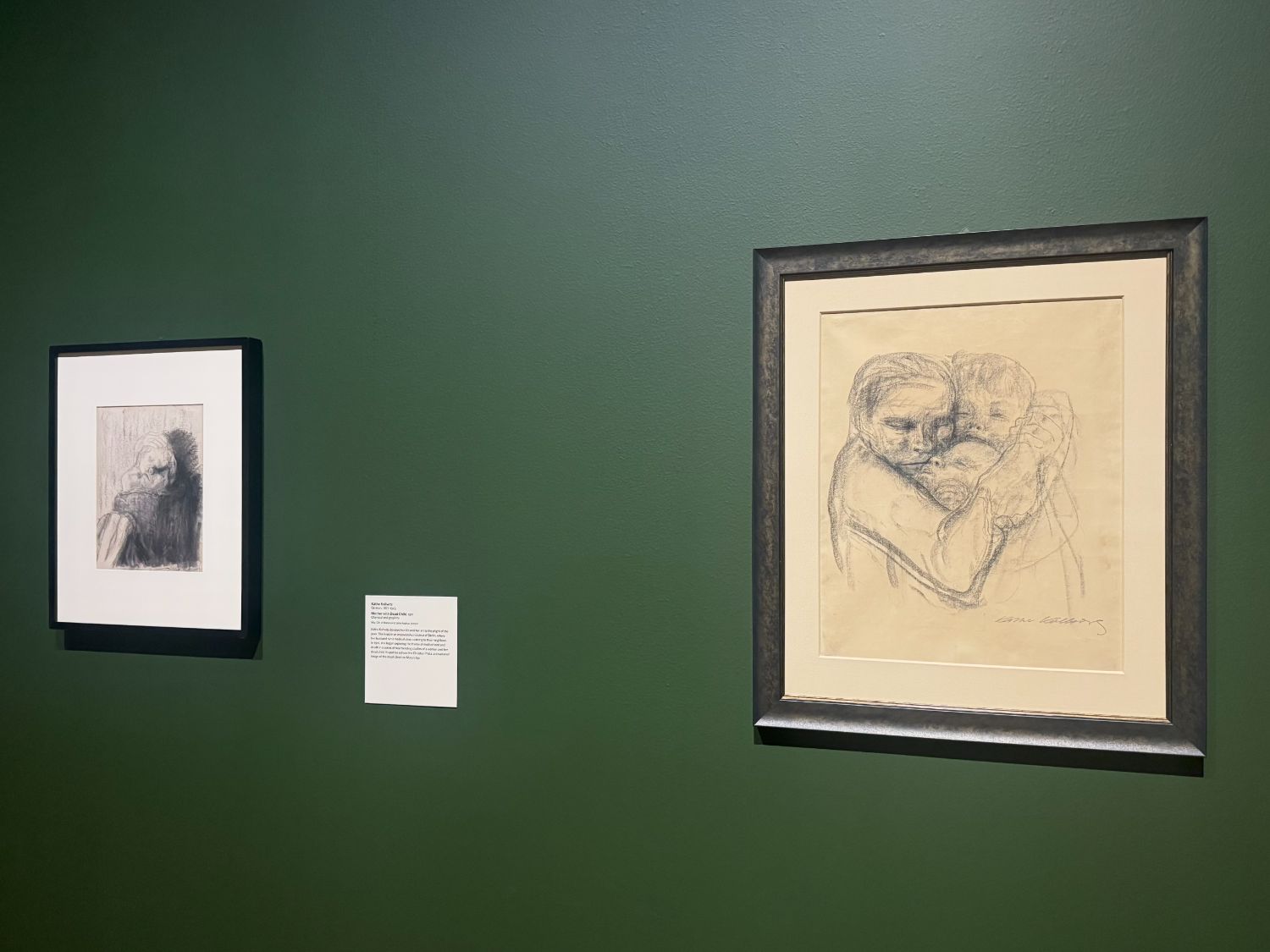 Top image: Installation view of The Large Blue Horses, 1911, Franz Marc, oil on canvas. Bottom image: Installation view of Mother with Dead Child, 1911, and Käthe Kollwitz, charcoal and graphite (left) and Mother Pressing Her Child To Her, 1932, Käthe Kollwitz, conté crayon on paper (right). Photo courtesy of Laura Laptsevitch.
I was happy to see The Large Blue Horses, a lending from the Walker Art Center, by Franz Marc (1880-1916) in the section titled Modes of Abstraction. I was happy to see it, not necessarily for its beautiful colors and overall composition. I have always held Marc in high esteem for his strong belief that animals were spiritually purer than humans. This realization came first than any aesthetic response. In a world torn by humans, Marc’s love for animals really resonates. (Marc died in 1916 while serving the German Army during the Battle of Verdun, France, he was 36).
For me, one of the most poignant works in the exhibition are the two drawings on motherhood by Käthe Kollwitz (1867-1945) found in a designated area halfway through the show. Her drawings live between realism and expressionism which grabs one’s attention immediately. Mother with dead Child from 1911 is a heartwrenching image that transcends its momentary scope, it quickly reminds us of the poverty, hunger and wars we see today. So is Mother Pressing Her Child To Her from 1932, originally a study for a sculpture, which remarkably captures the primal instinct and need of a mother to protect her children. (Kollwitz died in 1945 in Moritzburg near Dresden where she had found refuge from the war).
 Installation view of Fallen Man, 1915-16 (cast 1972), Wilhelm Lehmbruck, bronze. Photo courtesy of Laura Laptsevitch.
The section International Avant-Gardes recognizes German art dealers that were instrumental in promoting foreign art and artists. One of them was German-Jewish art dealer Heinrich Thannhauser whose Moderne Galerie in Munich hosted the first exhibition of works by Vicent van Gogh in 1908. Lovis Corinth’s (1858-1925) portrait of Thannhauser is a candid and rapidly executed strikingly soulful representation of the art dealer. (Thannhauser died in 1934 while attempting to flee Nazi persecution to Switzerland. Corinth died of pneumonia in 1925 in the Netherlands).
The 8 feet in length bronze cast of the sculpture Der Gestüezte (Fallen Man) by Wilhelm Lehmbruck (1881-1919) is one of the showstoppers. The male nude of the long figure collapsing on his knees is a staggering symbol of the suffering and human cost of war. I kept circling the sculpture along with other visitors in the gallery, its emotional pull is unique. (Lehmbruck committed suicide on March 25, 1919 in Berlin).
Seeing the 1940 cast of the statue Descending Man by George Kolbe (1877-1947) produced an unsettling effect, Kolbe was a highly favored artist of the Nazi Party who collaborated with the regime. According to the wall label, “the circumstances of its arrival at the Nationalgalerie are unknown”. (Kolbe died from bladder cancer in Berlin in 1947).
 Descending Man, 1939-40 (cast 1940), George Kolbe, bronze.
Organizers, curators, and interpretation specialists of this show have done a superb job providing the necessary context before entering the exhibit and inside. A timeline in the public area of the Target Wing at Mia richly illustrates connections between art and politics, including Nazi and Holocaust imagery. Wall labels in the galleries read accessible and not too long. And even though I am not into QR codes, these too amplify the experience of some of the works by connecting to an audio guide. The seating and literature available in the Reflection Room as one is about to exit the show is more than a nice touch. The wall label in this room reads, “we hope you’ll pause here to gather your thoughts”, like I said before, this exhibit can take a toll.
Last but not least, I would like to say something about the original press release for the US tour of this exhibition issued by the Neue Nationalgalerie in Berlin. It explicitly states that the exhibit was “developed specifically for an American [US] audience”. How did the Neue Nationalgalerie devise this goal? I could not help but to be reminded of how many US federally funded museums and cultural institutions have been warned by the current administration to stop promoting anything that resembles “anti-American ideologies” and “divisive narratives”. Or of the shock wave sent to the world by the closing of the office of diversity and inclusion at the National Gallery of Art in January 2025. Or of the violent detentions and killings by ICE. I ask, where are we heading politically, socially, and culturally in the US? What is freedom of speech for artistic expression going to look like in the future?◼︎
Modern Art and Politics in Germany 1910–1945 Masterworks from the Neue Nationalgalerie, Berlin will be on view until July 19 2026 at the Minneapolis Institute of Art. General Admission is $20; Youth 17 and Under Free.
We can't do it without you.
Help keep independent arts journalism alive in the Twin Cities.
We can't do it without you.
Help keep independent arts journalism alive in the Twin Cities.