
2024 McKnight Visual Artist Fellow: Alison Hiltner
Published February 17th, 2026 by Laura Laptsevitch
Alison Hiltner transforms heartbeat monitors, EEG data, tangled cords, and childhood memories into absurd, luminous machines that reveal the inner workings of a neurodivergent mind.
 Article made possible thanks to the
 McKnight Visual Artist Fellowship Program. Administered by the Minneapolis College of Art and Design.

Banner Image: Photograph of the heartbeat machine in Alison Hiltner's studio. Image courtesy of Laura Laptsevitch.
◼︎ ◼︎ ◼︎ ◼︎ ◼︎
This is the second in a series of articles profiling the six distinguished artists chosen as 2024 McKnight Fellows in Visual Arts, a grant program for mid-career artists in Minnesota that is administered by the Minneapolis College of Art and Design. The 2024 cohort includes Rachel Breen, Sophia Chai, Dahn Gim, Alison Hiltner, R. Yun Matea, and Chris Rackley.
Their two-year fellowship will culminate this spring with a group show, What Holds and What Breaks, opening May 7, 6–8pm and running through June 7 at the Minnesota Museum of American Art in St. Paul.
◼︎ ◼︎ ◼︎ ◼︎ ◼︎

Photo by Rik Sferra, courtesy of MCAD.
With Alison Hiltner, what you see is what you get. There is no question that the mind behind “We Have Merely Been Detected,” a three-dimensional interpretation of brain activity based on live-streaming EEG data, was that of anything other than a neurodivergent child of the 80s. The 80s references are clear: nods to Star Trek, Dr. Who, and Star Wars with the futurism and science fiction of it all. The neurodivergence, the way a nontypical brain thinks, sees, and processes, is clearer once analyzing the complex wires, the visual oddity, bluntness, and straightforward literal interpretation of ideas—that’s Alison.
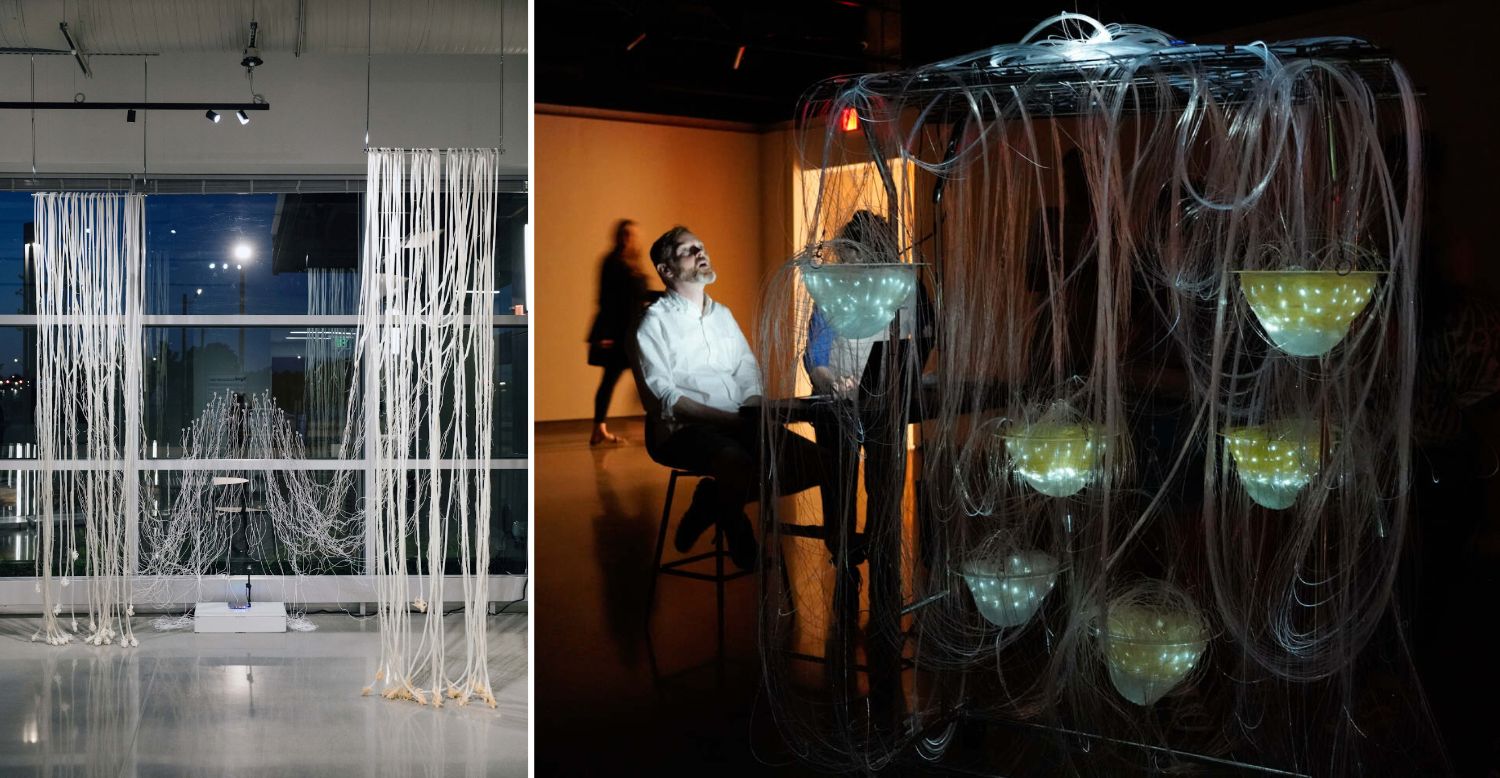 Left: Installation view of Survival Tactics - Body Heat. Image courtesy of the artist. Right: Installation view of We Have Merely Been Detected: One Night Prototyping Event. Image courtesy of the artist.
Every successful artist has defining traits that got them to where they are today. For Alison, it’s materiality and voice. Her work is elegant, gross, and absurd, drawing on early interest in biology, sci-fi, medical equipment, and state-of-the-art technology. The kicker for me is the light and suspension. As a two-time McKnight Fellow, it’s clear to me that Alison had something special. Recently out of “McKnight purgatory” (as she puts it), she applied exactly 5 years after receiving the grant in the 2018/2019 cycle.
If you want an idea of her voice, Alison experienced an ADHD and autism diagnosis—in addition to coming to grips with an aging body—all in the same week. And did she not hesitate to share this information with me a week later, the moment we met.
I met with Alison in her studio, and we spoke about art, life, and the journey that brought her to becoming the artist she is today.
Studio
After three tries and a phone call, I finally found Alison’s studio. It was inside a single-floor office complex, filled with therapists’ offices and a health clinic. Tucked next to a nurse practitioner’s office, her studio felt more like a mad scientist’s lab than the typical artist studio. Upon entry, I was confronted with cold LEDs lighting a 10x10 ft room filled with what looked like “experiments” like moss growing in the corner.
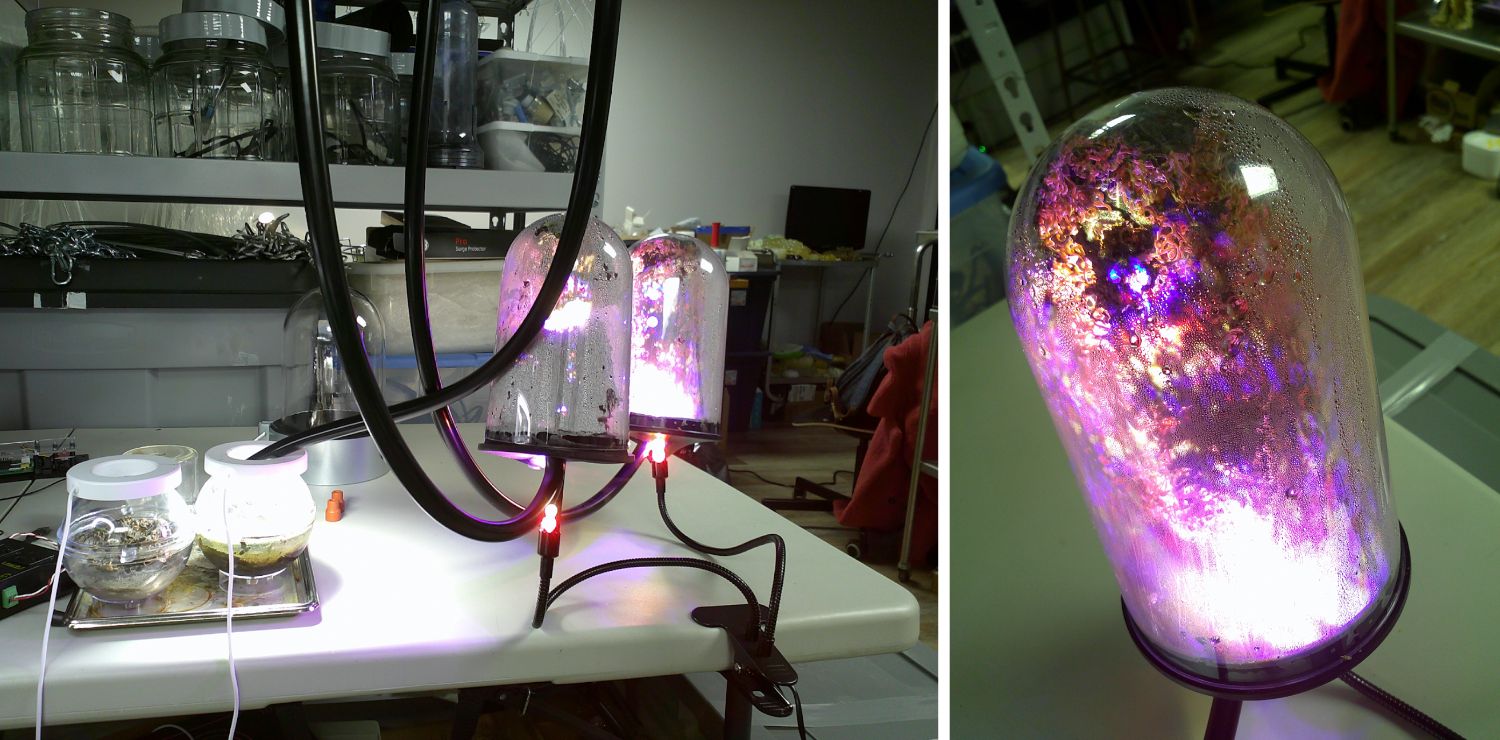
 Top left: Alison's moss over a work table in her studio. Top Right: Detail of the moss experiment. Bottom Left: Unlit components of We Have Merely Been Detected in Alison's studio. Bottom right: Image of Alison's studio. Courtesy of Laura Laptsevitch.
Beyond the moss, I noticed pollen gathered on metal rods and plants hanging from the ceiling. “My joke is I always want to make artwork that makes itself eventually.” Alison laughs. We get to talking, and I realize Alison could have had a career in STEM.
“Were you good at science in school?” I asked.
“Yes,” Alison grinned. “For a moment, I thought genetic engineering was the plan. Then I thought, actually… art is more fun. And that was that.”
Alison earned her BFA from the University of Kansas in Lawrence and began her career as a painter. But that didn’t last long. “I actually started my undergrad as a painter and realized I actually like sculpture way better.” She quickly found herself building objects into her canvases. “My painting instructor said, ‘Why don’t you just take a damn sculpture class?’ So I did, and the rest is history.”
Kansas
Growing up in Kansas was a mixed bag. Compared to Wichita, where she was born and raised, Lawrence, her university town, was an improvement. “It was pretty much a cooler version of where I'd lived my entire life prior.” She continued, “It's a weird place. Politically, I think it's gotten a bit better.” The 1990s were marked by religious extremism, public protests at military funerals, and graphic anti-abortion demonstrations. Alison’s parents attended a born-again church. The church was slightly more liberal, though Alison recalls a gay choir director everyone whispered about.
Childhood is a potent source of inspiration for Alison. Memories of both awe and social taboos run through her work. One story, in particular, stood out. A woman she had babysat for lost custody of her kids because she was accused of being a witch. Not figuratively. This mom was a practicing Wiccan. “This was a huge, huge scandal,” Alison says. “Her husband divorced her, she was ostracized from the church, and he got full custody of the kids.” She paused. “I loved her, but I was not allowed to talk to her again because she was a witch.” Still, Kansas had beautiful moments. “One of my favorite memories is the first time I saw Firefly erupt when I was a kid in Kansas. When they come out of the ground, lights floating all around you, I think that's such a humbling and amazing experience."
Minnesota
Alison moved to Minnesota to get her MFA. Minnesota was totally different. Minnesotans are nice, but they don’t say what they mean. “People in Kansas, I'll admit, you know their biases right away. It's kind of nice.”
Among the artists who have deeply influenced Alison’s practice, Rebecca Horn is the favorite. A professor introduced Alison to a work called Blood Machine. “It was the piece that completely changed my world,” she recalls. Overflowing Blood Machine (1970) is a sculpture and performance piece.

Image: Overflowing Blood Machine 1970, Rebecca Horn.
The performer is tied to the top of the glass container, wearing the tubes, as the blood pumps, which slowly circulates through the glass. The performer becomes an extension of the machine. Right away, I could see Horn’s influence in Alison’s work. The best example is the heartbeat machine. When you place your hand on the rubber, finger-like pieces, it tracks your pulse; it beats and pulsates to the beat of your own heart by simply placing your hand palm down.
The heartbeat machine also earned Alison’s best compliment of all time. A mother and her elementary-aged son came to one of her shows. The boy touched the silicone and felt his heartbeat. He asked if she was a scientist, and she told him no—she was an artist. The boy turned to his mother and said he wanted to be an artist when he grew up. “That’s the best thing I’ve ever heard in my life,” she said.
 Image: The heartbeat machine. Courtesy of Laura Laptsevitch
Alison’s work has always used cords. I had to ask about it.
“Is it form or function for you?”
“Form,” Alison said. “When I first started doing interactive pieces, sure, they functioned, they sent power. But one of the things I’ve always found funny about technology is that the more cords something has, the more complicated it looks, closer to a human nervous system.” She chuckled. “I’ve always thought that was hilarious.” And it’s true. The tangled wires make it all the more convincing.
“That’s all technology is, thousands of wires and cords. I love it. It’s both absurd and beautiful,” Alison says. “The lines really appeal to me,” I say.
“And the chaos really appeals to me.”
Neurodivergence
One thing that is true of Alison, as an artist and person, is that she is both tenderhearted and radically honest. “I've always thought rules were a suggestion.” She shares.
I might have attributed that to being a latchkey kid, but it turns out Alison has been navigating life with two undiagnosed conditions, ADHD and autism, for most of her life. In a conversation with her mother, Alison realized the signs had always been there. Her mom told her that many of her teachers had worried about just how sensitive she was. In fact, Alison’s kindergarten teacher said she was really afraid Alison was going to die of a heart attack before she was six years old. “I was like, ‘Jesus, Mom, isn’t it kind of weird that a six-year-old was that uptight?’” Alison recalls. Her mom shrugged it off as a phase. “And I thought, fair enough. Everyone thought it was a phase back in the ’80s.
 Image: Installation view of We Have Merely Been Detected. Image courtesy of the artist.
Alison always knew this was the life for her. While the identity of “artist” is difficult for some to embrace, Alison has held this identity since college. “I think as soon as I got out of school and started taking classes in undergrad, going after my BFA, I was like, oh yeah, this is it. This is what I’m going to do.” Though we joked about other careers Alison might have had, like editing high-resolution satellite images of space, it’s clear this is her dream job, even if it doesn’t always come easy.
“For me, it’s the only thing I was ever suited to do. I think it’s helpful when you get positive reinforcement. But I’ll be honest with you, nothing would have stopped me. Nothing. And maybe that’s what it takes to be an artist. You just have to accept that nothing will stop you.” Alison found early success after completing her MFA, showing work in a Chelsea gallery in New York. But that was short-lived. The gallery closed soon after. It taught Alison a valuable lesson: nothing is permanent. “It’s always a hustle.” She said, “Always trying to find the next person who’s going to listen to what you have to say, give you money, or give you an opportunity.”
The McKnight Fellowship
When I ask what advice she’d give to a young artist applying for something like a McKnight Fellowship, without a beat, she says, “Never stop.”
“It’s almost become a nervous tick for me,” she continues. “When I’m bored, instead of just watching TV, I’m like, I’m gonna just going to apply to something. So that’s what I do. For the most part, nobody’s going to come knocking on your door looking for you, because they don’t know you exist.”
“It’s a strange career,” she admits. “If I think about it too long, I’m like, why the fuck did I do this? This seems so strange. But then I default back to what we said at the beginning. I literally don’t know what else to be. It was this or nothing.” What she wants, ultimately, is simple and deceptively difficult. “I just want to be able to do what I want to do. Nobody really tells you that that’s the trickiest part. To do what you want to do. And to just keep going.”
I pause. “If someone were to call your work weird, where would that sit with you?”
“I’d take it as a compliment,” she says. “Because it’s very variable. And I think, for the most part, people nowadays actually use "weird" as a good thing. We’ve kind of accepted that outside-the-box thinking is something to be admired.” I smile. “I’ve always thought to myself, weird art’s going to change the world,” I say.
“Oh, totally. I mean, that’s what we do as artists. We offer a perspective no one asks for. But if we do it with enough finesse, people will listen to us.”
Absurdity as Clarity
When I imagine “the artist,” I often think of the Jeff Koons and Matthew Barneys of the world: someone pontificating from a city high-rise, surrounded by wealthy friends and collectors, steeped in philosophy, both highbrow and detached within an elite social sphere. But art does not have to look like that. It does not have to be the black dot on a blank canvas or insist on seriousness to be taken seriously. It can be weird, crude, gross, and playful and still be rigorous and thoughtful. In fact, the absurd, the weird, and the irrational are exactly what we need in gallery spaces right now.
In moments of collective unease, absurdity becomes an act of clarity. It has always thrived in uncertain times. When reality grows too large, too frightening, or too illogical to confront directly, artists respond by exaggerating it, making it stranger, sharper, and at times grotesque. Alison Hiltner’s work embraces bluntness, materiality, and visual oddity. Even in its strangeness, her work is too bright and shiny to resist.◼︎
Visit Alison Hiltner's website at alisonhiltner.com or follow her on Instagram @alisonhiltner.

We can't do it without you.
Help keep independent arts journalism alive in the Twin Cities.
We can't do it without you.
Help keep independent arts journalism alive in the Twin Cities.