
2024 McKnight Visual Artist Fellow: Sophia Chai
Published January 8th, 2026 by Laura Laptsevitch
Sophia Chai upends the conceptual notion of modern painting, photographing the painted walls and floor of her studio corner.
 Article made possible thanks to the
 McKnight Visual Artist Fellowship Program. Administered by the Minneapolis College of Art and Design.

Banner image: photograph of Sophia Chai's studio by Laura Laptsevitch
◼︎ ◼︎ ◼︎ ◼︎ ◼︎ ◼︎
This is the first in a series of articles profiling the six distinguished artists chosen as 2024 McKnight Fellows in Visual Arts, a grant program for mid-career artists in Minnesota that is administered by the Minneapolis College of Art and Design. The 2024 cohort includes Rachel Breen, Sophia Chai, Dahn Gim, Alison Hiltner, R. Yun Matea, and Chris Rackley.
Their two-year fellowship will culminate this spring with a group show, What Holds and What Breaks, opening May 7, 6–8pm and running through June 7 at the Minnesota Museum of American Art in St. Paul.
◼︎ ◼︎ ◼︎ ◼︎ ◼︎ ◼︎
 Photo by Rik Sferra, courtesy of MCAD.
If you’ve ever stood before a giant wall of color and felt both captivated and confused, you’ve already entered the world of Barnett Newman, Mark Rothko, and Helen Frankenthaler; vast planes of color and forms that command entire rooms—this was the language of the color field painters of the 1950s and 60s.
Few works test the limits of color field painting like Rothko’s famous “red room”, a gallery space with 9 monumental paintings known as the Seagram Murals; these paintings swallow you up in a tall, long, dimly lit space at the Tate Modern in London. Formally, the works are simple: maroon, burgundy, red; and of course shapes: every possible iteration of the rectangle. What strikes me most about this work, especially when seeing it in person, is the way the room, the dim lights, and the foreboding red, makes you feel. The color red, specifically in a dimly lit room, is felt more than it is known.

Mark Rothko’s Seagram Murals, 1958–59, at the Tate Modern, London. Photo: Tate London/Art Resource, NY. Artwork: © 1998 Kate Rothko Prizel & Christopher Rothko / Artists Rights Society (ARS), NY.
When speaking with Sophia Chai, I realized that although she identifies primarily as a photographer, she shares much of the color field painters’ visual language. In her most recent exhibition, Mother Photography, Chai unveils seven works that read at first glance as minimalist paintings—but are, in fact, photographs of lines and fields of color she painted directly onto her studio walls and floors. Using a palette rooted in mid-century modernism—yellow, blue, and red—she upends the concept of the “painting” altogether through her ritual of analog photography.
When considering Rothko’s “Red Room” alongside Mother Photography, I see several points of overlap: the geometry, color, the texture and application of the dry brush, and a sense of visual economy. The difference lies, of course, in the medium–photo–but also in the kinds of questions each work sets out to ask. Famously, Rothko’s “red room” questions the viewer’s inward experience, asking them to sit with the solemn hues, dim light, and enclosed space. It poses a fundamental question of what: what presence fills the room? Chai’s work opens outward. Like two mirrors facing each other, her photographs create an infinite loop of images—endless iterations of the painted corner of her studio. Her images ask a different question: where. Where is this space? Where does this image begin?
Chai’s work, despite the inclusion of modern references, has a distinctly postmodern inflection: irony, self-reflexivity, and a deliberate blurring of medium and perception. This, above all, is what makes the work so compelling—and why I was so excited to meet her.
I sat down with Sophia Chai in her studio and we talked about abstraction, the camera obscura, and the winding road that led her to, of all places, Rochester, Minnesota.
 Left:ㅣㅣㅡ (0516-02) 2025, Inkjet print on Hanji (Korean Mulberry Paper) 45x36 inches (image); 51x40 inches (paper) Right:ㅣㅣㅡ (0516-01) 2025, Inkjet print on Hanji (Korean Mulberry Paper) 45x36 inches (image); 51x40 inches (paper). Image courtesy of the artist.
For decades, Chai has fused modernist sensibility with new media. Since her MFA at the University of Illinois at Chicago, she’s been exploring the question of “where”, and how planes and space shape that inquiry.
I discovered a fabulous piece when studying Chai’s work, a Polaroid referencing Piet Mondrian’s famed Composition in Red, Blue, and Yellow. This piece marks an early milestone in Sophia’s enduring fascination with Piet Mondrian.
I ask, “What drew you to referencing Mondrian in your work?”
She smiled. “Mondrian is someone that I have been interested in for some time. Looking at the trajectory of his evolution is something that I found really interesting,” she said, “he goes from painting these beautiful trees, and then it gradually becomes more and more distilled until it becomes these flat compositions of primary colors.” Chai adds, “Finding this way of distilling down to something so elemental as a philosophical inquiry is an approach that I found so compelling.”
 Left: Study of a Mondrian Composition, Side View with a Figure, 2008, Polaroid, 4x5 inches. Right: Study of a Mondrian Composition, Side View, 2008, Polaroid, 4x5 inches. Images courtesy of the artist.
Chai’s fascination with mid-century abstraction is a recurring theme in her work. An even more potent theme is the evolving nature of photography. Researching the nature of photography has led her through experiments with Polaroids, analog cameras, and even transforming her studios and apartments into camera obscuras. When I asked Chai “How do you define photography?”, I was met with a long, thoughtful pause.
“A photograph can exist on our phone, on our computer, or it could be printed on a piece of paper.” She paused once more. “Photography is such an elusive medium. I don't really know how to pin down. It becomes more ungraspable the more I engage with it.” She chuckled, “Maybe that's why I am still making photographs.” A prime example of “where” location, space, and planes in Chai’s work is her exhibition Construction, R. created during her Jerome Fellowship, 2019–2020.
The photograph on the left is a photograph of the painted corner of Sophia’s previous studio space in Rochester. It is 40x32 inches big. The mounted photograph was hung on the gallery wall at MCAD where Sophia painted the gallery wall with the same color red. If the viewer had been Sophia's studio, they would have had the experience of the rectangle collapsing into a trapezoid. But in the gallery space, you see a photograph of a straight rectangle against an angled corner wall.
 Left: Construct, R5 (detail). Right: Construct, R5, 2021, archival inkjet print on Hahnemühle photo Rag paper mounted on Dibond, wall paint, 56x105 in. Images courtesy of the artist.
One might think she is trying to “fool” the viewer, but for Chai, the goal isn’t deception. Rather, it’s a statement about perception as a whole. “I think an illusion happens because we have certain expectations about what and how we see through the camera,” Chai shared, “It’s not just trickery. The camera reveals the rupturing of the way we want to see the world - organized onto a grid and fixed in time.”
Early Years
The world is anything but organized. Chai’s life is a testament. The artist immigrated to the United States from South Korea when she was just a teenager. “I remember feeling really lonely.” She said, “I was 14 years old. We lived in Queens. And my parents, as immigrants, had to work a lot, their first job was working at a Korean Deli. It's working 12 hours and commuting like an hour and a half to get into Manhattan.”
Sophia spent much of her time exploring the city. In fact, Chai’s first experience in Modern Art was on the streets of New York. She attended Stuyvesant High School, a specialized math and science academy, then located in the East Village; the school later moved to Battery Park City. She applied after seeing a friend in her neighborhood dress in a totally different style–all black. “I was like, oh, I really like this style,” and thought, “I'm gonna go to school where this girl goes to school." Because of this new school, Chai had a pass that let her ride buses and subways for free until 7 o’clock each evening. While roaming Greenwich Village, she suddenly found herself on Broadway in Soho, at the Guggenheim’s former satellite space, confronted by a vast, body-scale cyanotype. “I got interested, then walked in, and it turned out to be Robert Roshenburg and Susan Weil.”
 Left: Installation view of "Robert Rauschenberg: The Early 1950s" exhibition at the Guggenheim Museum SoHo, New York, 1992. Photograph Collection. Robert Rauschenberg Foundation Archives. Right: Robert Rauschenberg and Susan Weil, Untitled [double Rauschenberg], 1950, Cyanotype, 82 1/2 x 36 1/4 in. (209.6 x 92.1 cm), Collection Cy Twombly Foundation.
“They were body photograms,” Chai explained, “A large body scale cyanotype. I didn't even know what cyanotype was then.” She thought to herself, “I don’t know what this is, but I want to learn more.” It took years before Chai developed what is her “now” studio practice. After earning her MFA in photography, Chai struggled to take the time to develop new work.
Initially, she turned her apartment into a camera obscura and just sat there. “I really wanted to get down to the bottom of this thing.” She said, “I would just watch the light change, around sunset, in my apartment in Chicago.”
 University of Illinois at Chicago, Art and Design Hall, 400 S. Peoria St., Fifth Floor, 2002. Image courtesy of the artist.
She did the same to a room when she lived in San Francisco, but wasn’t making any work at the time. A turning point occurred when she rented a separate studio space in New York.
“It ended up being five years of not making work.” She continued, “Then finally I said, okay, I'm gonna get myself a studio space.” She got a windowless room in New York City, about 110 square feet, with the starting rent at $450. “It was a decent chunk of my lab-technician salary at the time.” she said. “So then it's like, okay, I better show up and get the most out of it.” She would not leave until she made something, even if it was really small. “I think those times were so instrumental for me.” Chai shared. ”It's allowing yourself that kind of time to wait for an idea to emerge and to act on that idea.” She laughed, “It seems like such a foolish thing, you know, sitting in this windowless room and spending all my evening hours just being alone and just doing this funny thing with a camera and some tape. I think that's when I realized, okay, I guess I'm an artist.”
The Studio
Sophia Chai is now based in Rochester, Minnesota. I had the privilege of visiting Chai in the studio and seeing the cameras, tape, and painted walls firsthand. I stepped into a warehouse and was confronted with what looked like a movie set or video shoot. Visiting an artist’s studio comes with certain expectations: scraps of paper pinned to walls or notes scattered across tables. What’s less expected is a stage on wheels surrounded by painted walls and camera equipment aimed directly at a corner.
At first glance, I couldn’t make sense of the corner. It wasn’t until I examined the archival prints and digital images that the pieces fell into place.
It is easy to assume that Sophia’s warped perspectives are the result of camera manipulation or post-production, but that's not the case. The illusion of flatness is achieved entirely through her painting process in the corner of the room, a method known as anamorphic perspective. She works by constantly moving back and forth between the physical corner and her camera, meticulously aligning different points in the space to the grid on her viewfinder. For instance, a line that appears perfectly straight moving from the wall to the floor in the final photograph was actually painted "bent" in the physical set. By distorting the paint across the architecture to compensate for the room's depth, she ensures the shapes only resolve into a flat plane when viewed through the lens.
Her room, walls, and a short rectangular stage become the subjects of each photograph.

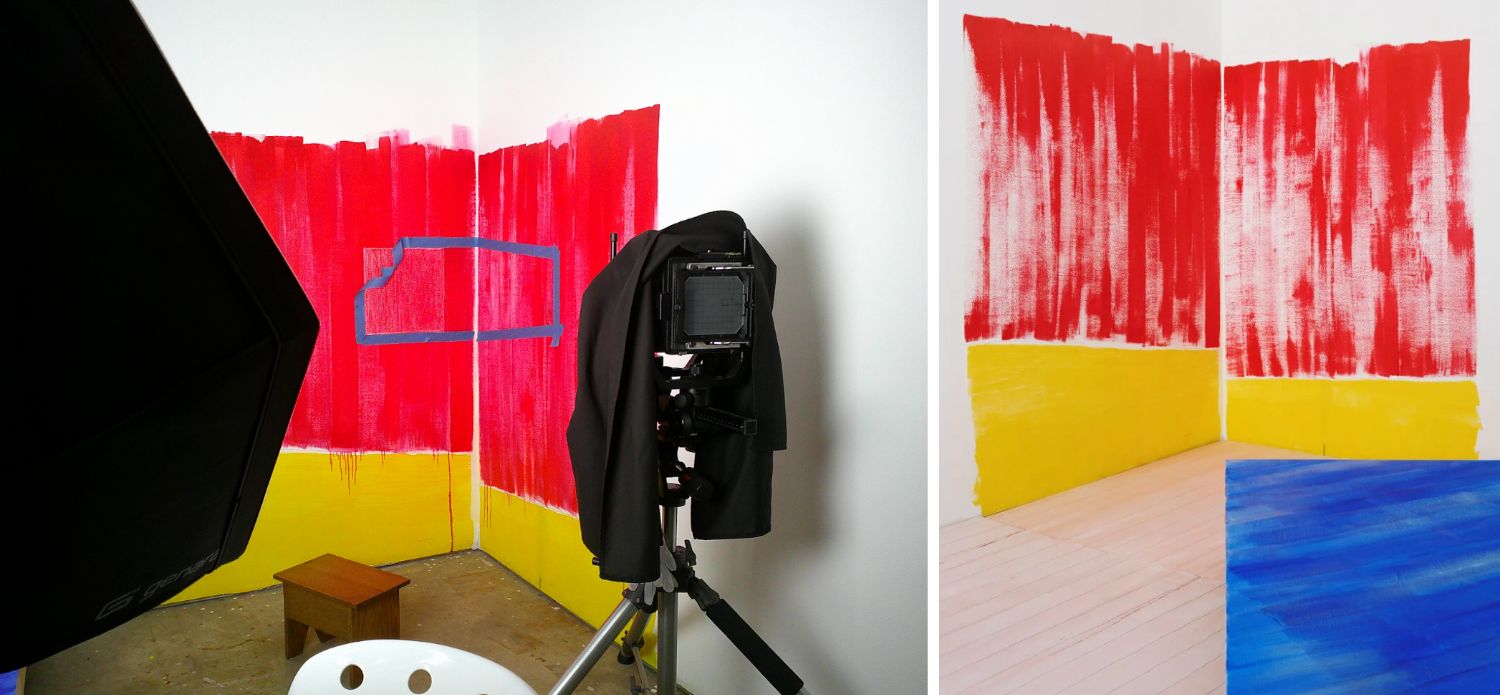 Upper: Sophia Chai's studio space in Rochester, Minnesota, photo by Laura Laptsevitch. Lower Left: Detail of painted studio corner and camera, photo by Laura Laptsevitch. Lower Right: ㅕ(0509-02),2025, Inkjet print on Hanji (Korean Mulberry Paper) 45x36 inches (image); 51x40 inches (paper).
To the left of the red and yellow walls, in the center of the room, I came across a print I recognized on the artist’s work table. It sat next to a sketchbook, rubber gloves, water, and paint. While studying the works on her table, the conversation shifted toward her series Mouth Space.
The piece reminded me of Chai’s work in the Hair+Nails show, drawing on inspiration from the Korean alphabet, Hangul. This body of work represents perhaps the most rigorous "problem-solving" phase of Chai’s career: the attempt to spatialize sound. The project finds its logic in Hangul, the Korean alphabet. Unlike the Latin alphabet, Hangul is an orthography of mimesis; the shapes of the consonants—such as ㄱ (k), ㄴ (n), or ㅁ (m)—are designed to mimic the physical position of the tongue, teeth, and throat during speech. She describes the work as an attempt to “capture” sound, to give it a physical presence in her studio.
Like the works from Mother Photography, this beautiful image also began with Chai’s movie-esqu set: the haphazard painting, rolling stage, and flattening of diagonals into straight lines on the wall; If I didn’t know better, I would think this was a lithograph or monoprint.
 Left: Work table in Sophia Chai's studio, photo by Laura Laptsevitch. Right:ㅣ(0221-03), 2023, Archival pigment print on Hahnemühle Ultra Smooth Photo Rag Paper mounted on Dibond with an archival protective satin coating, 36 x 30 inches (91.4 x 76.2 cm).
It’s amazing how a small idea, like photographing a painted corner of your wall, can turn into this powerful series, one that distinguishes Chai from other photographers and even other painters. Perhaps this is why she is one of the six to receive the McKnight.
I asked Chai about the fellowship. “Do you remember where you were and how you felt when you got the news?”
“I think I was getting groceries at Trader Joe’s. I have a daughter—she’s 12—and she was at her piano lesson. It's a 30-minute, 45-minute lesson. During that time, I just drive over to Trader Joe's and get groceries.” She smiled. “It was very exciting.” One aspect Chai emphasized was the sense of recognition the fellowship brings and how that recognition builds confidence, especially through studio visits from enthusiastic curators. “I’ve been working this way for so long,” Chai shared. “There was a time when nobody was asking to see my work. Having this kind of public recognition just gives you another layer of confidence to try new things.”
So far, the “new things” I discovered in Chai's studio are both timely and clever. I keep coming back to this idea of “where" when reflecting on Chai's work and studio practice. Much of the way we are introduced to art in 2025 is through the barrier of time and space—a photograph taken of the actual thing in an entirely different location. How ironic to make that experience, the experience of viewing the removed photographed image of a perceived artwork, the painted wall, the art itself.
Rothko might have been successful at manipulating his audience with the “red room” and addressing important questions in his day: the role of painting, subject versus object, color and meaning. But Sophia Chai has been successful in answering the questions of our day: how do we really know what we know? Chai is making art that is historically informed, self-aware, and medium-blurring. Her work is a reminder that the simplest ideas, when executed with clarity and persistence, can open a space entirely its own.◼︎
Visit Sophia Chai’s website at www.sophiachai.com or follow her on Instagram @sophiachainyc.

We can't do it without you.
Help keep independent arts journalism alive in the Twin Cities.
We can't do it without you.
Help keep independent arts journalism alive in the Twin Cities.