
Looking Back, Looking Closely: Ten Twin Cities Exhibitions That Shaped 2025
Published December 15th, 2025 by Laura Laptsevitch
Ten standout exhibitions that defined a year of experimentation, memory, and material-driven storytelling in the Twin Cities.
Banner image: Edgar Arceneaux Skinning the Mirror (Autumn 1), 2025. Acrylic Paint, silver, glass on canvas. 80 x 120 in. Image courtesy of Laura Laptsevitch
Reflecting on 2025
As the year comes to a close, it’s worth reflecting on the exhibitions that left a lasting mark on the Twin Cities art scene. From immersive multimedia installations to intimate explorations of memory, identity, and materiality, 2025 offered a wealth of shows that challenged, inspired, and connected audiences. In this roundup, I highlight ten exhibitions that stood out for their inventive approaches, compelling narratives, and the ways they deepened our engagement with contemporary art. Each exhibition invites a closer look, revealing layers of meaning, experimentation, and cultural resonance that continue to shape the local artistic landscape. As you explore these ten exhibitions, enjoy discovering the work that resonates most, and don’t hesitate to share your favorite moments with friends and fellow art lovers. Enjoy. -Laura
Tia Keobounpheng: Gas’kal (In the Space Between)
 Gas'kal (In the Space Between) (detail), installation view. Image courtesy of the gallery.
Starting the year off strong, from January 5th to February 8th, Tia Keobounpheng exhibited new work at Weinstein Hammons Gallery, titled Gas’kal (In the Space Between). The show included abstract tapestries of various scales, using methods of weaving and embroidery. Through the process of measuring, drafting, drilling, coloring, and threading, the artist explored both ancestral and cellular memory. In this show, Keobounpheng studied the space “in between” based on the term “Gas’kal,” one of several North Sámi words in North Sámi (davvisámegiella) that speaks to ways we can experience the feeling of between (gas’ka). Being between (gaskas) or between, in, and among (gas’kii) also described her experience of the time making this work. When I look at the work, the “dance” that makes it so interesting is the push and pull of exactness and complexity versus the harmony and balance of color and composition. But ultimately, what Keobounpheng wanted viewers to notice is the gap, the small spaces in between the thread where “grief is held with hope and new perspectives are revealed.”
For more, see The Making in the Unraveling: Tia Keobounpheng on the visceral, the familial, and the somatic by Cory Eull for more on the show.
Roshan Ganu: रातराणी: The Night Blooming Jasmine
 रातराणी: The Night Blooming Jasmine, installation detail. Photo courtesy of the artist.
Roshan Ganu exhibited a new body of work, an immersive multimedia piece, as a part of the Minnesota Artists Exhibition Program at the Minneapolis Institute of Art from November 23rd, 2024, through February 23rd, 2025. The show, Roshan Ganu: रातराणी: The Night Blooming Jasmine, used immersive videos and paintings to explore the mythology and contemporary celebration around the Hindu festival of lights, Diwali. It specifically explores the night before Diwali, when the demon king Narakasura is burned in effigy. Ganu explores this ritual and her own fascination with the night in रातराणी: The Night Blooming Jasmine.
As a frequent Mia visitor and school guide for children, this installation had something for everybody. For the school guides at the Mia, this was a perfect place to bring children on their school tours. School groups loved the immersive experience, and it opened up opportunities for larger conversations surrounding our tour themes, Art and Identity, Art and Our Environment, and even the Art of South Asia in the collection on the same floor, a few halls down.
For more, see Roshan Ganu: रातराणी: The Night Blooming Jasmine by Saina Kathi.
Untitled 19: SooVAC’s 19th Juried Exhibition
 Untitled 19, installation detail. Photo by Cory Eull.
From February 15 to March 23, 2025, Soo Visual Arts Center opened its highly anticipated Untitled 19 Exhibition, an annual juried show that provides opportunities for artists working in any medium and at any stage of their career. It was curated by the director of galleries and exhibitions at the Minneapolis College of Art and Design, Keisha Williams. Both curator and juror, Williams selected 31 artists out of 231 artist submissions.
The exhibition featured work centered on themes of connection, intimacy, and the human condition. Williams thoughtfully balanced an exhibition that brought together painting, sculpture, collage, and textiles with artists of all ages and backgrounds.
The Untitled 19 Artists included: Sarah Abdel-Jelil, Christopher Alday, Nancy Ariza, bARBER, Chelsea Brink, Monica J. Brown, Julia Megan Burchett, Perci Chester, Dudley Diaz, Jessica Dzielinski, Dean Ebben, Marjorie Fedyszyn, Effie Ferguson, Becca Gallandt, Steven Jacobson, Jessica Kitzman, Arnée Martin, Ashley Mary, Anavi Mullick, Terrence Payne, Jasmine Peck, Jon Reischl, Jacoub Reyes, Lynaea Russom, Mami Takahashi, Anda Tanaka, Dan Tran, Amy Usdin, Patrick Vincent, Dani Wagner, and Forrest Wasko
For more on the show, see This is where we start: Suspension, softness, and shared weight in SooVAC’s 19th 'Untitled' show by Cory Eull.
Charles Matson Lume: lacuna (for Gustaf Sobin)

lacuna (for Gustaf Sobin)' at the Minneapolis Institute of Art / Charles Matson Lume
From March 22 through June 29, 2025, in Mia’s U.S. Bank Gallery, Charles Matson Lume exhibited new work created during his 2024–2025 sabbatical, a site-specific installation titled lacuna (for Gustaf Sobin). In the work, he used common materials such as plastic sheeting, holographic tape, and light. While the word lacuna itself is less common, meaning a gap or empty space, it is derived from the Latin words for lake or lagoon.
The themes present in lacuna (for Gustaf Sobin) center on light, poetry, beauty, and mortality. When I look at the work, its subtlety, especially the way light refracts and bends gently across the ceiling and floor, is what makes the work so memorable.
I remember seeing Lume’s lacuna (for Gustaf Sobin) in person. I first noticed the installation from outside the gallery. I was touring Giants with a friend when we sat in the lounge space adjacent to the U.S. Bank Gallery space. Something about the exhibition caught my attention. A moment later, I read the wall label: Charles Matson Lume’s lacuna (for Gustaf Sobin). I remember saying out loud, “that was my professor!” One practice I remember from Professor Lume when I was a student, and a practice he continues with his students to this day, is reciting poetry before class. It comes as no surprise that this installation is rooted in poetry.
The push and pull between presence, the stillness of the plastic sheeting, and the movement of light creates a moment that is difficult to forget.
Hear Charles Matson Lume speak on his work in Charles Matson Lume: lacuna (for Gustaf Sobin).
Rachel Collier — A Sleep and a Forgetting
 Gallery view of A Sleep and a Forgetting. Courtesy of Laura Laptsevitch.
From March 21st to April 20th, Rachel Collier exhibited new work at HAIR+NAILS, Rachel Collier—A Sleep and a Forgetting.
This body of work, spanning Collier’s practice over the last few years, features dyed wool that has been tufted and felted onto canvas, often mimicking the application of paint. In some pieces, Collier applies both paint and dyed wool on the same surface. In this specific exhibition, Collier unveiled the non-representational imagery developed through her practice, offering a glimpse into her deep understanding of the materials and the evolution of her technique. Ultimately, the show shares a powerful and visible dialogue between her inner emotional landscapes and their manifestation on the canvas.
On the work, Collier shared this statement on her site.
“I understand the grid as an artist’s tool for design and structural support but also, more urgently, as a net cast into deep space, expanding and contracting presence and meaning, slicing through the atmosphere to become a two-dimensional framework that cradles the energy flowing through it. Through this lens, the grid becomes a place for magical thinking, beyond any sense of a fixed reality. Emotions and obstacles can be as powerful as deep space is infinite, and through their perspectival vantages, abstractions emerge. The grid measures my artistic impulse to describe explosive psychic landscapes while providing containment and constructing peaceful resolution, creating a tension which I endeavor to emphasize visually through color relationships, scale and material. These formal elements embody perseverance, and their rendering is delivered in the spirit of celebration.”
A Sleep and a Forgetting marked Collier's second full-building solo show at the HAIR+NAILS Minneapolis storefront and her thirteenth exhibition with the gallery, including shows in New York City, Los Angeles, Miami, and Rochester, MN.
Giants: Art from the Dean Collection of Swizz Beatz and Alicia Keys
 Ebony G. Patterson (Jamaican, born 1981), . . . they were just hanging out . . . you know . . . talking about . . . ( . . . when they grow up . . .), 2016, beads, appliqués, fabric, glitter, buttons, costume jewelry, trimming, rhinestones, glue, and digital prints. Courtesy of Laura Laptsevitch.
“Giants: Art from the Dean Collection of Swizz Beatz and Alicia Keys” occupied the minds of many Minnesota art lovers in 2025. The traveling show was on view from March 8, 2025, to July 13, 2025. It was a landmark exhibition and the first major public presentation of The Dean Collection, owned by musicians and cultural figures Swizz Beatz (Kasseem Dean) and Alicia Keys.
Organized by the Brooklyn Museum, Giants brought together nearly 100 significant works by Black diasporic artists, including Gordon Parks, Jean-Michel Basquiat, Lorna Simpson, Amy Sherald, and many others. The exhibition reflected the Deans’ long-standing commitment to supporting both established and emerging artists, while opening up meaningful conversations about art, culture, and identity. The exhibition was organized by Kimberli Gant, Curator of Modern and Contemporary Art, and Indira A. Abiskaroon, Curatorial Assistant of Modern and Contemporary Art, at the Brooklyn Museum.
For Jim with Love: Collection of a Storyteller

Left: Jaune Quick-to-See Smith, Storyteller for Jim With Love, by 2004. Right: Lauren dela Roche, untitled, 2018 Credit: Courtesy of the Bockley Gallery
From July 26 to August 2, Bockley Gallery presented a fundraising event and exhibition, Jim With Love: Collection of a Storyteller. The show was comprised of Jim Denomine's art collection, a body of work that, throughout his life, he purchased, traded, and was gifted artworks from friends, colleagues, relatives, mentors, students, and strangers near and far. In collaboration with the Jim Denomie Estate and the Jim Denomie Memorial Scholarship, Bockley Gallery celebrated and shared Jim’s collection with the public, selling select artworks for $100, $300, or $500 in the spirit of Jim’s Garage Sale events, with the desire to find their next good home.
Some artists represented in the show were: Jaune Quick-to-See SmithTa-coumba T. Aiken, Regan Balzer, Rick Bartow, Marwin Begaye, Frank Big Bear, Douglas Beasley, Dick Brewer, Gabrielle K Brown, Julie Buffalohead, Delphine Cadoré, Andrea Carlson, Steven Carlyle Moore, Teresa Cox, Lauren dela Roche, Francisca Delgado, Mary Esch, Joe Feddersen, David Feinberg, Luis Fitch, Pam Gaard, Frank Gaard, Carl Gawboy, Vance Gellert, Joseph Giannetti, Mary Gibney, Ruthann Godollei, Greg Graham, Laura Hallen, Glen Hanson, Kristine Heykants, John Hitchcock, Alexa Horochowski, AE Kalnik, Caitlin Karolczak, Joyce Koskenmaki, Alex Kuno, Anne Labovitz, Mary Jane Mansfield, Stu Mead, Carolyn Lee Anderson, Beth Moore Love, George Morrison, Betty Moynahan, Rachel Mulder, Linda Munn, Jon Neuse, Stuart Nielsen, Keegan Onefoot-Wenkman, Dougie Padilla, Camilo Pardo, Galilee Peaches, Montana Picard, Reda Rackley, Wendy Red Star, Marcela Rodriguez Aguilar, Alexandra Rozenman, Jenny Schmid, Matt Sesow, Joseph H. (wahalatsu?) Seymour, Jr., Dietrich Sieling, Joe Sinness, Susan Skrzycki, Sean Smuda, TL Solien, Alec Soth, Darrell Spotted Horse, Xavier Tavera, Ellen Thomson, Toma Villa, Star WallowingBull, Russ White, Brian Wiggins, Sara Woster, Melanie Yazzie
Queering Indigeneity

Awanigiizhik Bruce (Mikinaak-Wajiw Anishinaabe, Nehiyawe, Michif)
with Dyana DeCoteau-Dyess (Anishinaabe, Michif, Northern Cheyenne, and Arikara), Niizhoomanidoowag manidokewining, aaniish naa izhi-noojimo’idizowaad? (How do they heal themselves in a Two-Spirit ceremony?), 2025, Photograph. Courtesy of the Minnesota Museum of American Art.
Unveiled to the public on September 18, 2025, and remaining on view through next year, the Minnesota Museum of American Art presents Queering Indigeneity, a long-term, intergenerational initiative that centers 2-Spirit, Native queer, and gender-expansive artists in the Upper Midwest. Guided by Penny Kagigebi, the project amplifies Indigenous voices and reshapes who is supported and centered at the museum, offering audiences a more complete and layered understanding of the region’s art and artists. Since 2023, the partnership has emphasized intergenerational learning, shared artmaking, and sustained mentorship, building community among artists. Rooted in the M’s history of community-led collaboration, the project reflects a commitment to Indigenous practices that nurture care, continuity, and cultural leadership.
Addressing the lasting impacts of colonial disruption that have marginalized 2-Spirit people, Queering Indigeneity affirms 2-Spirit knowledge as essential to healthy Tribal communities and creates space for cultural reclamation and healing.
For more on Queering Indigeneity, see Queering Indigeneity: Reclaiming history and celebrating presence in the present at the Minnesota Museum of American Art by Carl Atiya Swanson.
Dyani White Hawk: Love Language
 Gallery view of Love Language, opening night. Courtesy of Laura Laptsevitch.
On view from October 18, 2025, to February 15th 2026, Dyani White Hawk’s (Sičáŋǧu Lakota, b. 1976) Love Language explores the connection between people, generations, and the natural world, through15 years of multimedia work. Rooted in Lakota forms and motifs, the exhibition challenges conventional narratives in abstract art while engaging urgent issues of settler colonialism and Indigenous histories.
Organized into four sections—See, Honor, Nurture, and Celebrate—the show traces White Hawk’s practice from early quillwork, beadwork, and paintings, which weave together her Sičáŋǧu Lakota and European American ancestries, to projects centered on family, ancestors, and community. Works like the Quiet Strength series honor Indigenous women, while the video installation LISTEN (2020–ongoing) amplifies contemporary Native voices in their own languages. The final section, Celebrate, presents large-scale glass mosaics, beaded sculptures, and her monumental Wopila | Lineage paintings. Through shimmering patterns and meticulous craftsmanship, these works highlight the deep cultural, historical, and material resonance of Indigenous traditions, inviting viewers to reflect on both ancestry and contemporary experience.
I have to say, I attended the opening reception for Love Language on the 17th, and it has been a while since I have seen such a turnout at a fine arts exhibition. For context, I could hardly see the work because the room was filled wall to wall with viewers.
To learn more about Dyani White Hawk and some of the pieces in Love Language, see our article 2021 McKnight Visual Artist Fellow: Dyani White Hawk written by Russ White.
The Fall By Edgar Arceneaux
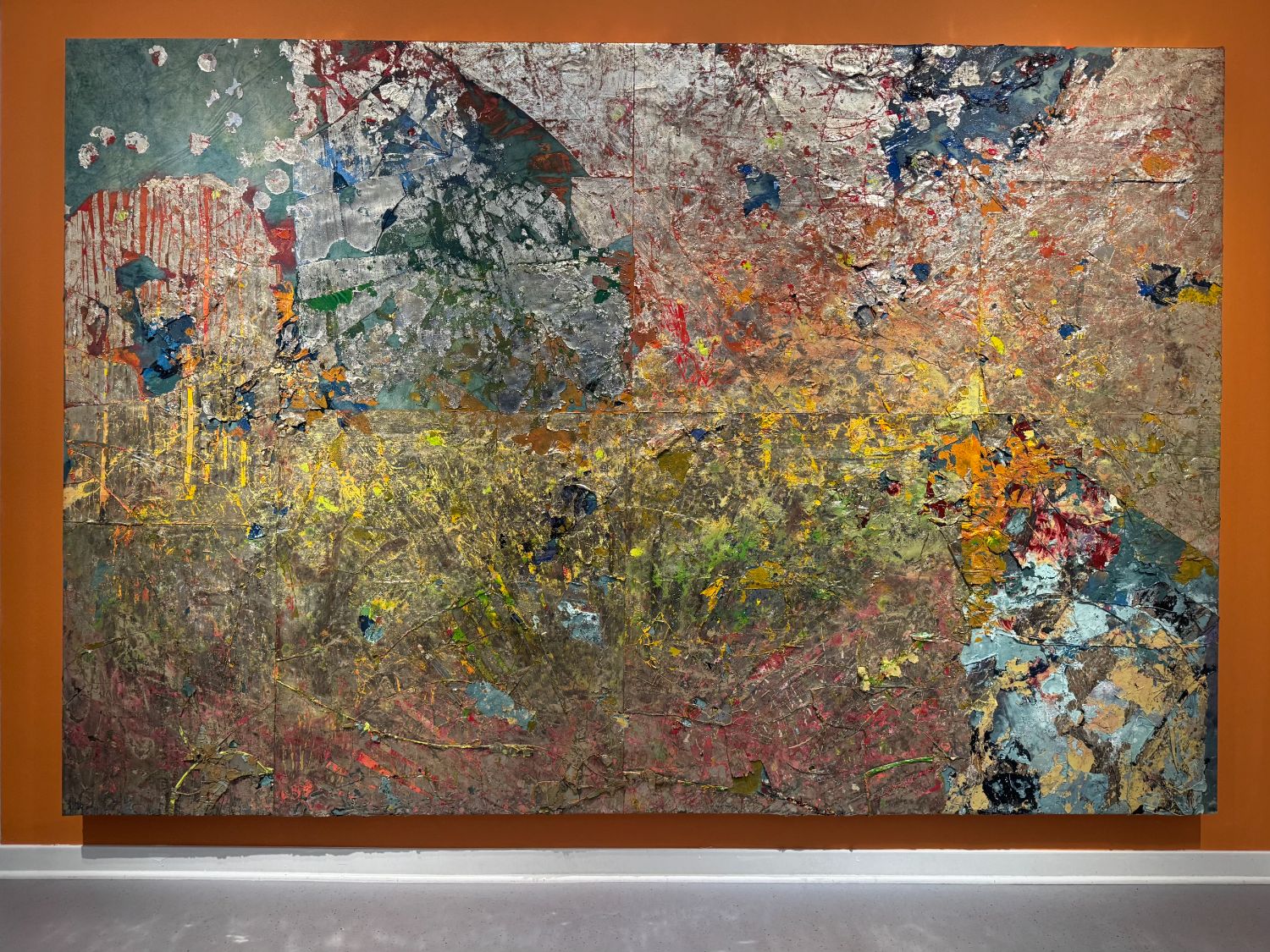 Gallery view of Skinning the Mirror (Autumn 1), 2025. Acrylic paint, silver, glass on canvas. 80 x 120 in. Courtesy of Laura Laptsevitch.
This show is top of mind for me; it's the most recent exhibition I attended in the roundup.
On view from November 8th to December 20th, Dreamsong presents The Fall. The Fall was Dreamsong’s inaugural solo exhibition with Los Angeles–based artist Edgar Arceneaux and marks the culmination of his two-year Minneapolis residency through a collaborative program with the Walker Art Center and MCAD. The exhibition centers on paintings from Arceneaux’s ongoing Skinning the Mirror series, which drew on Minnesota’s seasonal ecologies and his long-standing investigation of race, memory, and the gaps within American historical narratives.
While working in Minneapolis, Arceneaux organized the paintings by season, moving from winter through autumn and using distinct color palettes tied to local climate and light. Material from each season carried forward into the next, with earlier paintings serving as underpaintings and creating layers of accumulated time. Using silver stripped from mirrors and transferred onto canvas, Arceneaux embraced oxidation and atmospheric change as part of the work, allowing the surfaces to shift before being sealed. Originally shaped by the artist’s experience caring for his mother through dementia, the series explored fractured knowledge and reflection, later taking on deeper sociopolitical resonance amid rising authoritarianism in the United States.
Arceneaux’s engagement with Minneapolis was resolutely place-based, informed by repeated visits, conversations with local artists and activists, and a sustained attention to the region’s ecological fragility.
For more on Edgar Arceneaux, see the show at Dreamsong and check out Material History: Dreamsong debuts Edgar Arceneaux's mirror works at Frieze LA by Russ White.
2026...What's Next?
As 2025 winds down, the question naturally turns to what’s next for 2026. If this year is any indication, we can expect continued experimentation with craft (ceramic, textiles), bold storytelling, and work that pushes the boundaries of material and medium. Artists and institutions alike are deepening their engagement with community, history, and the environment, while inviting audiences to slow down, look closely, and think critically. Whatever the year brings, there’s no doubt that the Twin Cities will remain a vibrant, dynamic place for art—full of surprises, new voices, and exhibitions that challenge and delight in equal measure.◼︎
For more exhibitions, artist talks, and other visual arts events coming up around the Twin Cities, check out our Upcoming Events page or follow us on Instagram at mplsart.
We can't do it without you.
Help keep independent arts journalism alive in the Twin Cities.
We can't do it without you.
Help keep independent arts journalism alive in the Twin Cities.